FOOD FOR THE HUNGRY, INTERNATIONAL
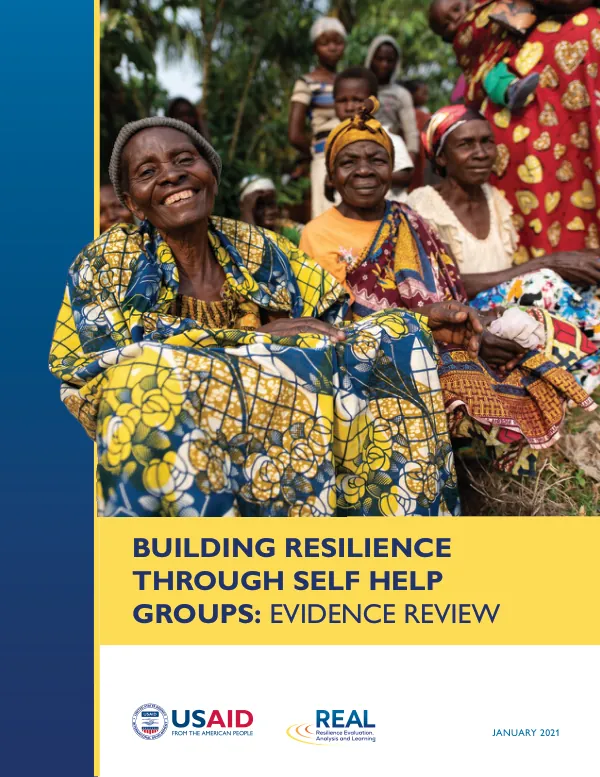
Building Resilience through Self Help Groups: Evidence Review
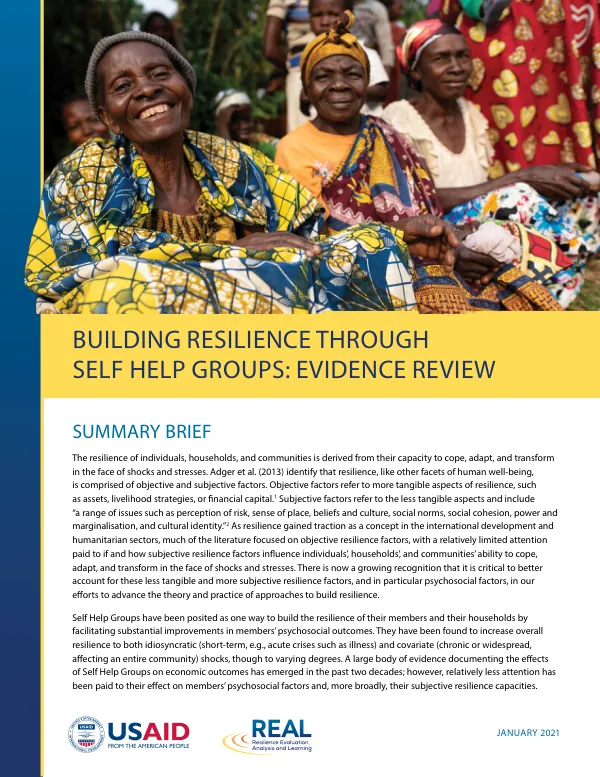
The resilience of individuals, households, and communities is derived from their capacity to cope, adapt, and transform in the face of shocks and stresses.
2021 · 42 pages
Sign in to readA free account is required to download.
Abstract
Resilience, like other facets of human well-being, is comprised of objective and subjective factors. Objective factors refer to more tangible aspects of resilience, such as assets, livelihood strategies, or financial capital. Subjective factors refer to the less tangible aspects and include perception of risk, sense of place, beliefs and culture, social norms, social cohesion, power and marginalisation, and cultural identity. Self Help Groups have been posited as one way to build the resilience of their members and their households by facilitating substantial improvements in members' psychosocial outcomes. They have been found to increase overall resilience to both idiosyncratic (short-term, e.g., acute crises such as illness) and covariate (chronic or widespread, affecting an entire community) shocks, though to varying degrees. A large body of evidence documenting the effects of Self Help Groups on economic outcomes has emerged in the past two decades; however, relatively less attention has been paid to their effect on members' psychosocial factors and, more broadly, their subjective resilience capacities. The report by the Resilience, Evaluation, Analysis and Learning (REAL) Associate Award synthesizes the state of knowledge on the linkages between psychosocial factors and resilience through the lens of Self Help Groups. The objective of the report is two-fold. First, it seeks to provide practitioners and researchers with a better understanding of what is already known about how psychosocial factors contribute to resilience through Self Help Groups. Second, in synthesizing the state of knowledge on this topic, it highlights the gaps in the current evidence base to inform a learning agenda. Self Help Groups facilitate their members' psychosocial factors, which in combination with economic factors, strengthen members' and their households' abilities to be more resilient in the face of shocks and stresses. The evidence base is limited and grounded largely in peer-reviewed studies from South Asia, but our review indicates that Self Help Groups, and women's groups more broadly, can have substantial consequences for a range of women's psychosocial factors. Women who are members of Self Help Groups will have greater psychosocial benefits, particularly social capital and women's empowerment. Women's groups and Self Help Groups have been widely shown to expand women's social networks and increase a shared sense of trust amongst women, generating solidarity amongst group members, and creating capacities and institutions for collective action. Further, Self Help Groups have been widely shown to have a positive impact on women's individual and collective empowerment by encouraging women's civic and political engagement and local collective action. The evidence reviewed for this report strongly suggests that, in combination with economic factors that are facilitated through Self Help Groups, these psychosocial factors strengthen members' and their households' capacity to be more resilient in the face of shocks and stresses. A combination of factors central to Self Help Groups and the building of their members' psychosocial factors and resilience, including access to savings, loans, and financial institutions, technical support and advice, as well as group solidarity and networks, has been identified. While a great deal of investment has gone into building resilience to disaster and conflict across countries and contexts, the literature highlights that work to-date has fundamentally focused on the more tangible aspects of resilience, with relatively limited attention paid to the subjective factors, including psychosocial factors.