THE MANOFF GROUP
Health systems in the SDG era: consolidating and building on the gains
Global health today faces unprecedented challenges despite significant progress over the last two decades.
2017 · 5 pages
Sign in to readA free account is required to download.
Abstract
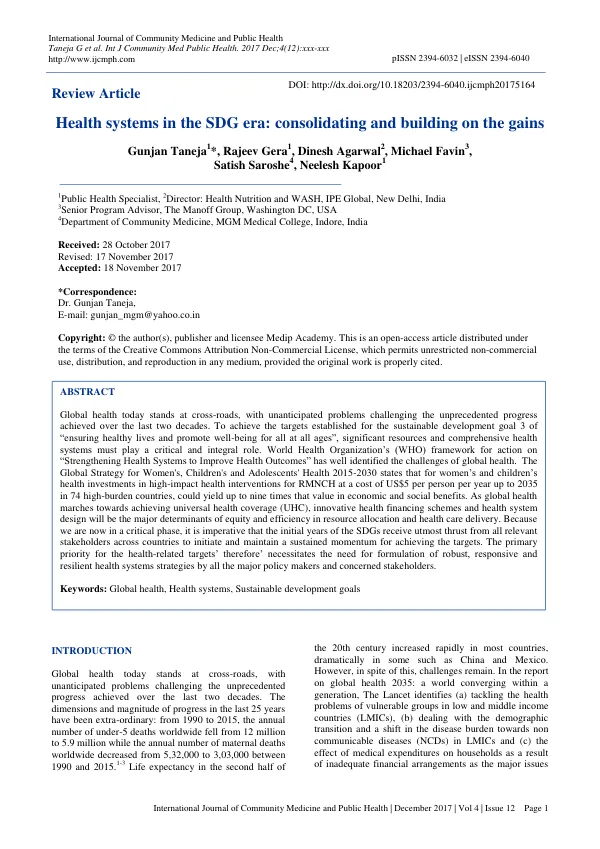
The annual number of under-5 deaths worldwide fell from 12 million to 5.9 million between 1990 and 2015, while the annual number of maternal deaths worldwide decreased from 5,32,000 to 3,03,000 between 1990 and 2015. Life expectancy in the second half of the 20th century increased rapidly in most countries, dramatically in some such as China and Mexico. However, challenges remain, including tackling the health problems of vulnerable groups in low and middle-income countries, dealing with the demographic transition and a shift in the disease burden towards non-communicable diseases in low and middle-income countries, and the effect of medical expenditures on households as a result of inadequate financial arrangements. The World Health Organization's (WHO) framework for action on "Strengthening Health Systems to Improve Health Outcomes" has identified the challenges of global health. The Global Strategy for Women's, Children's and Adolescents' Health 2015-2030 states that investments in high-impact health interventions for Reproductive, Maternal, Newborn, Child and Adolescent Health (RMNCH) at a cost of US$5 per person per year up to 2035 in 74 high-burden countries could yield up to nine times that value in economic and social benefits. As global health marches towards achieving universal health coverage (UHC), innovative health financing schemes and health system design will be the major determinants of equity and efficiency in resource allocation and health care delivery. The challenges faced by health systems across the globe have been well identified in the WHO's framework for action. Large health inequalities persist not only in underdeveloped countries but also within rich ones, such as the United States of America (USA) and Australia, where life expectancy still varies among population sub-groups by over 20 years. The recent Ebola virus outbreak in 2014-15 and the Zika virus epidemic have highlighted the importance of having responsive and resilient health systems in a changing world. The weak health systems in the countries affected by the outbreak augmented the direct damage caused due to the disease. Despite the pressing situations, multiple scenarios across countries have illustrated the gains achieved by adapting the health systems to priority needs and available resources. A prime example is the reduction of health inequalities in Thailand through improved insurance coverage, equitable distribution of primary health care infrastructure and intervention coverage. The Ethiopia health workers program, cadre of lady health workers (LHW) in Pakistan and the accredited social health activist (ASHA) program of India have clearly demonstrated the impact of sound human resource policies in creating systems to bridge the last mile. Improved financing schemes in Colombia and augmenting the institutional capacity for policy analysis in Kyrgyzstan are other success stories demonstrating the positive impact of augmenting health systems. To learn from past successes and failures, it is imperative to prioritize the need for responsive and resilient health systems to address the growing needs of a dynamic and fast-paced world. The WHO health system framework should be implemented in totality by ensuring sound interrelationships between the six system building blocks for achieving the overall goals and outcomes. A comprehensive approach to engage and promote community participation and involvement of civil society organizations (CSOs) towards developing sound and effective health systems is also essential.
Related documents