FINTRAC
Bunching Onion Quality Standards for the Local Market
Bunching onions are a crucial crop for Cambodia's HARVEST producer groups and clients, as they are in high demand in the local market.
2014 · 2 pages
Sign in to readA free account is required to download.
Abstract
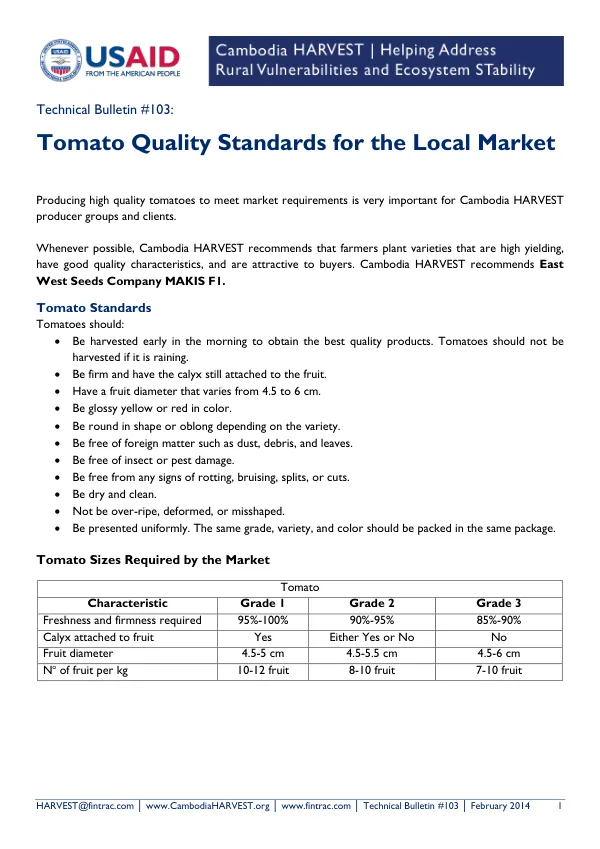
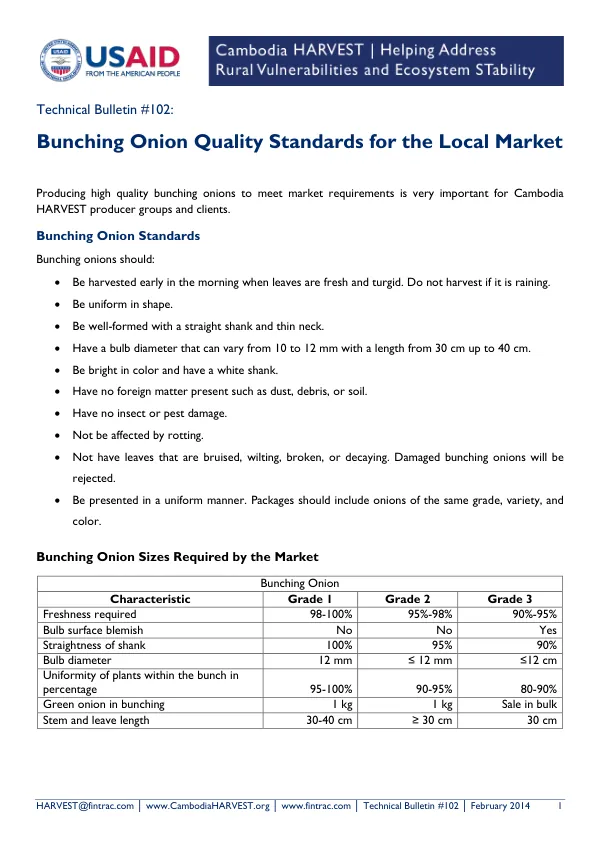
To meet market requirements, it is essential to produce high-quality bunching onions that conform to specific standards. Bunching onions should be harvested early in the morning when leaves are fresh and turgid, and not when it is raining. They should be uniform in shape, well-formed with a straight shank and thin neck, and have a bulb diameter that can vary from 10 to 12 mm with a length from 30 cm up to 40 cm. The bulb should be bright in color and have a white shank, with no foreign matter present such as dust, debris, or soil. Insect or pest damage, rotting, and bruised, wilting, broken, or decaying leaves are also unacceptable. Damaged bunching onions will be rejected. To ensure consistency, packages should include onions of the same grade, variety, and color. The market requires bunching onions to meet specific size and quality standards, which are outlined in the following table. Bunching Onion Sizes Required by the Market Bunching Onion Characteristic Grade 1 Grade 2 Grade 3 Freshness required 98-100% 95%-98% 90%-95% Bulb surface blemish No No Yes Straightness of shank 100% 95% 90% Bulb diameter 12 mm ≤ 12 mm ≤12 cm Uniformity of plants within the bunch in percentage 95-100% 90-95% 80-90% Green onion in bunching 1 kg 1 kg Sale in bulk Stem and leave length 30-40 cm ≥ 30 cm 30 cm The market requires different grades of bunching onions, with Grade 1 being the highest quality. Grade 1 bunching onions must have a freshness requirement of 98-100%, no bulb surface blemishes, and a straightness of shank of 100%. In contrast, Grade 3 bunching onions can have a freshness requirement of 90-95%, bulb surface blemishes, and a straightness of shank of 90%. The market also requires bunching onions to be sold in specific quantities, with Grade 1 bunching onions being sold in 1 kg packages and Grade 3 bunching onions being sold in bulk. The quality standards for bunching onions are outlined in the following table. Rejected products include those with gray botrytis mold, over-mature bunching onions, broken leaves, and other defects. The market requires bunching onions to meet specific quality standards to ensure consistency and quality. By adhering to these standards, HARVEST producer groups and clients can meet the demands of the local market and increase their sales.