USAID DEC
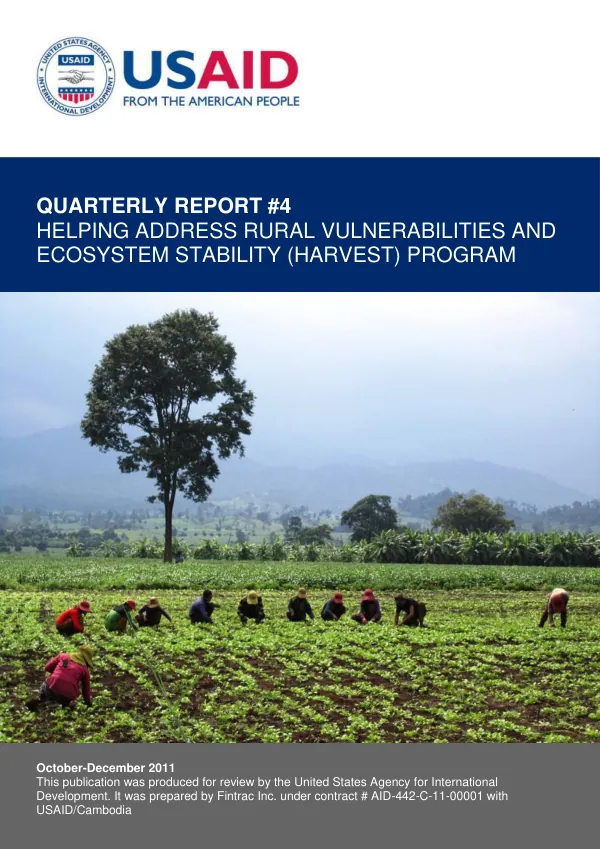
Quarterly Report #4: Helping Address Rural Vulnerabilities and Ecosystem Stability (HARVEST) Program
Sign inFINTRAC
Quarterly Report #4: Helping Address Rural Vulnerabilities and Ecosystem Stability (HARVEST) Program
The agricultural development initiative in the USAID-HARVEST program began in 2011 with a focus on increasing food security for 70,000 rural Cambodian households.
2011 · 48 pages
Sign in to readA free account is required to download.
Abstract
The program aims to improve productivity, reduce postharvest losses, and enhance market access. The program's approach involves developing value chains for rice, aquaculture, and horticulture, as well as promoting sustainable natural resource management and biodiversity conservation. The program also focuses on strengthening the capacity of local organizations and improving the enabling environment for agricultural development. In the fourth quarter of 2011, the program implemented various activities to achieve its objectives. The program launched activities in two new provinces, Siem Reap and Kampong Thom, and expanded technical assistance in Battambang and Pursat. The program also experienced severe floods, which destroyed hundreds of thousands of hectares of rice fields and displaced thousands of people. However, the program's farmers were able to adapt and increase their incomes due to the good agricultural practices adopted. The program's highlights include: - 2,728 farmers and other clients received training and technical assistance in all program areas, with 46% being female. - A total of 13,636 participants have received training to date, with 8,492 participants trained in basic agricultural practices. - The program's early demonstrators in rice and horticulture production earned average profits of $790 and $100, respectively, and improved yields to 3.6 tons per hectare and 24% above the national average. - The program launched a new management program with six management programs to create a consistent supply of fingerlings to address seasonal scarcity. - The program introduced eight new aquaculture techniques to help clients increase productivity and produced and distributed seven technical bulletins on pond management practices. - The program strengthened 17 agriculture and aquaculture suppliers through training and product demonstrations. - The program improved the capacity of local NGO partners through training in technical and management areas. - The program launched a nutrition initiative to improve the eating habits of rural families through participatory methods and messaging. - The program provided training to rice millers on better standards and procedures for rice processing and selling. - The program installed billboards in 31 villages to display information about different credit providers to help farmers make better decisions. - The program completed an analysis of six markets to determine market opportunities for import substitution. - The program initiated rehabilitation design work on two canals to enable 900 farmers to plant three crops per year. The program's activities are focused on addressing the challenges faced by rural Cambodian households, including poor productivity, lack of market access, and environmental degradation. The program's approach aims to improve the livelihoods of rural households and increase their resilience to climate change.