USAID
Burkina Faso Regional Program (BFRP) Success Story
The Burkina Faso Regional Program (BFRP) was implemented in the Nord region of Burkina Faso from October 2020.
2020 · 1 pages
Sign in to readA free account is required to download.
Abstract
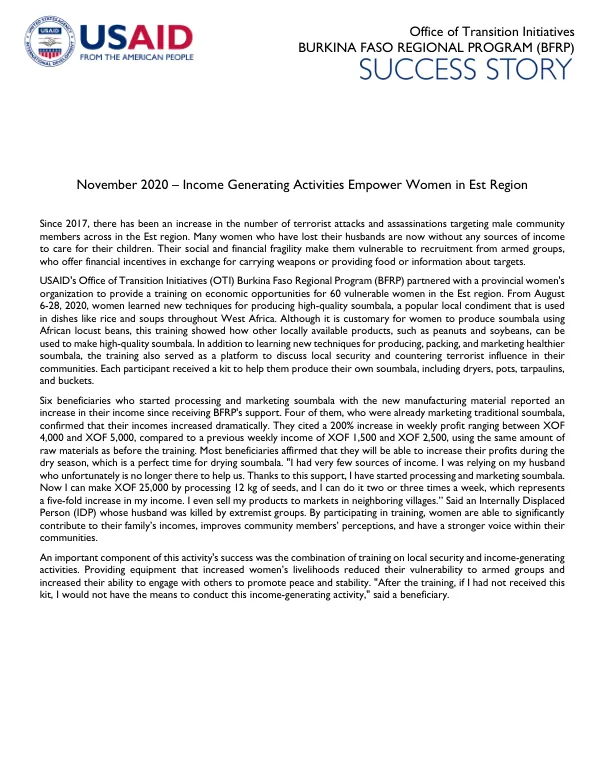
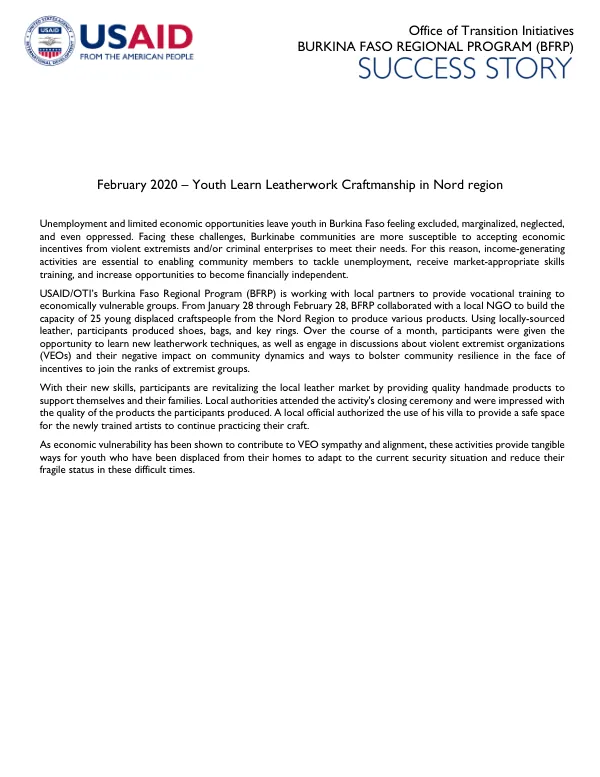
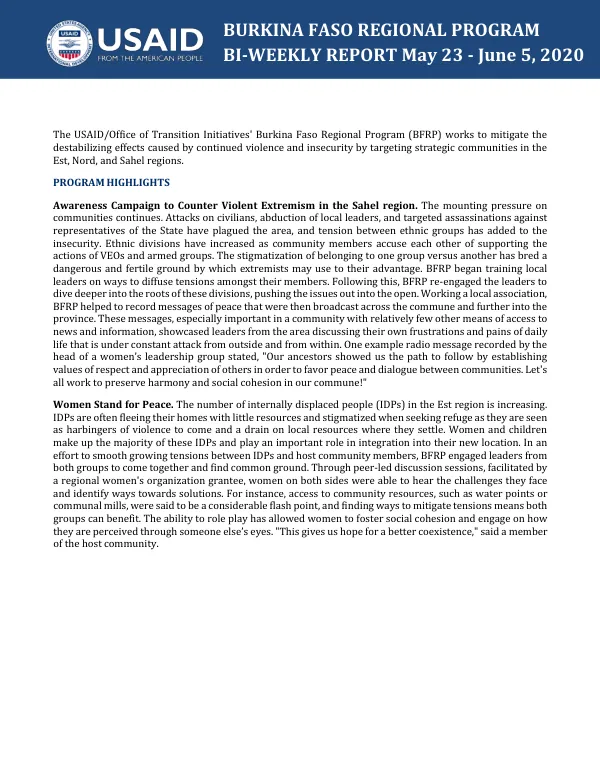
The program aimed to strengthen community leaders' response to radical groups led by religious leaders, whose extremist messages threatened to further divide communities. These groups had been spreading divisive messages, leading some communities to resort to violence due to a lack of constructive initiatives or strategies to counter violent extremism and radicalization. USAID/OTI's BFRP collaborated with a national civil society organization to train 40 local religious leaders on how to teach their followers about violent extremism and radicalization, while promoting religious tolerance in conflict situations. The training, which took place from March 2-4, 2020, focused on the basic principles of violent extremism, roles and responsibilities of religious leaders in conflict mitigation and peacebuilding strategies, and the factors that enable violent extremism and radicalization. During the training, participants learned how using certain words or ideas during their sermons and religious teachings could deepen divisions between community members. One religious leader reported a change in his approach, stating that he now teaches his congregation that insecurity is caused by extremists, rather than Muslims. To demonstrate their commitment to a more stable and peaceful community, the participants established a committee made up of eight religious and traditional leaders representing the most commonly practiced faiths and ethnicities in the community. The committee, which intentionally did not have a hierarchical structure, organized a meeting to discuss topics that would be helpful to share with radio listeners to promote awareness. Five inter-religious committee members recorded three radio shows on these topics, reaching at least 67,000 listeners. A listener commented that the fact that religious leaders were coming together and speaking the same language encouraged people to accept their differences, as the way leaders behave and speak influences their followers. The program's efforts to bring religious leaders together to host radio programs on critical issues fostered inter-religious tolerance and facilitated important interactions between leaders and their followers. This allowed for frank conversations that helped dispel misperceptions held by listeners across the four provinces. The program's impact was evident in the increased awareness and understanding of the importance of promoting religious tolerance and peacebuilding strategies among community members.