EQUAL ACCESS INTERNATIONAL
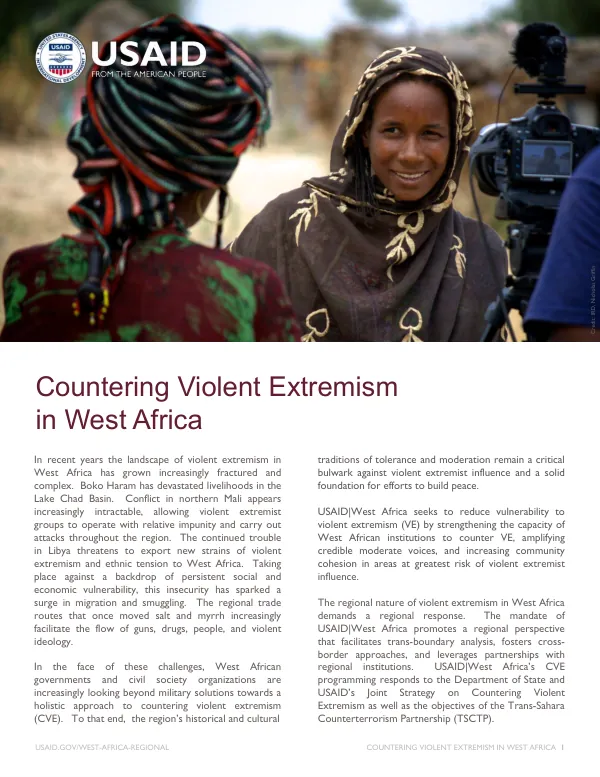
Countering Violent Extremism in West Africa
Violent extremism in West Africa has grown increasingly complex and fractured in recent years.
2016 · 6 pages
Sign in to readA free account is required to download.
Abstract
Boko Haram has devastated livelihoods in the Lake Chad Basin, while conflict in northern Mali has allowed violent extremist groups to operate with relative impunity. The continued trouble in Libya threatens to export new strains of violent extremism and ethnic tension to West Africa. This insecurity has sparked a surge in migration and smuggling, with regional trade routes facilitating the flow of guns, drugs, people, and violent ideology. West African governments and civil society organizations are increasingly looking beyond military solutions towards a holistic approach to countering violent extremism (CVE). The region's historical and cultural traditions of tolerance and moderation remain a critical bulwark against violent extremist influence and a solid foundation for efforts to build peace. USAID|West Africa seeks to reduce vulnerability to violent extremism by strengthening the capacity of West African institutions to counter VE, amplifying credible moderate voices, and increasing community cohesion in areas at greatest risk of violent extremist influence. The regional nature of violent extremism in West Africa demands a regional response. USAID|West Africa promotes a regional perspective that facilitates trans-boundary analysis, fosters cross-border approaches, and leverages partnerships with regional institutions. The mission's CVE programming responds to the Department of State and USAID's Joint Strategy on Countering Violent Extremism as well as the objectives of the Trans-Sahara Counterterrorism Partnership (TSCTP). USAID|West Africa has a long history of CVE programming, dating back to 2006. Early efforts were characterized by one-off projects addressing specific issues in limited geographic areas. However, in 2009, the mission launched Peace through Development, a three-year project operating in Chad and Niger that marked the Agency's first attempt at holistic CVE programming. Following the success of the model, Peace through Development II, a five-year project targeting Burkina Faso, Chad, and Niger was launched in late 2011. The mission's new portfolio of CVE efforts leverages experience to date but strikes out in new directions. The approach seeks to support direct CVE programming in communities at risk of VE influence while focusing on the critical long-term goal of building West African capacity. By prioritizing learning, flexibility, and adaptability, the mission seeks to understand and meet new CVE challenges as they emerge. Programming principles include focusing on regional and national African partners, fostering long-term solutions by building West African government and civil society capacity to counter VE, and adapting to the environment and the threat. The mission coordinates closely with other USAID CVE-relevant programming in the region, including USAID Niger Office & OTI, USAID|Mali, USAID|Nigeria, USAID Chad Office, USAID Cameroon Office, USAID Mauritania Office, and USAID|West Africa target countries. As violent extremism does not respect borders, national and global action has to be complemented by enhanced regional cooperation. The UN Plan of Action to Prevent Violent Extremism, December 2015, emphasizes the importance of narratives, expanding access to information, and increasing dialogue and exchange on CVE and peace concepts. The mission has implemented several CVE projects, including the Niger Community Cohesion Initiative, the Participatory Responsive Governance Project in Niger, the Nigeria Regional Transition Initiative, the NOUR project in Mauritania, and the ACCORD project in Mali. The geographic focus of the mission's CVE efforts recognizes that the underlying causes of violent extremism are present in much of the Sahel, but that limited U.S. Government resources demand a selective and focused approach. The mission advances a portfolio that blends systems-level investments in the broader enabling environment with intensive community-level programming in limited geographic zones at immediate risk of VE influence.