USAID DEC
Business Case and Model Contract for Build-Operate-Transfer Septage Management Project
Sign inDEVELOPMENT ALTERNATIVES, INC./FINNET
Business Case and Model Contract for Build-Operate-Transfer Septage Management Project
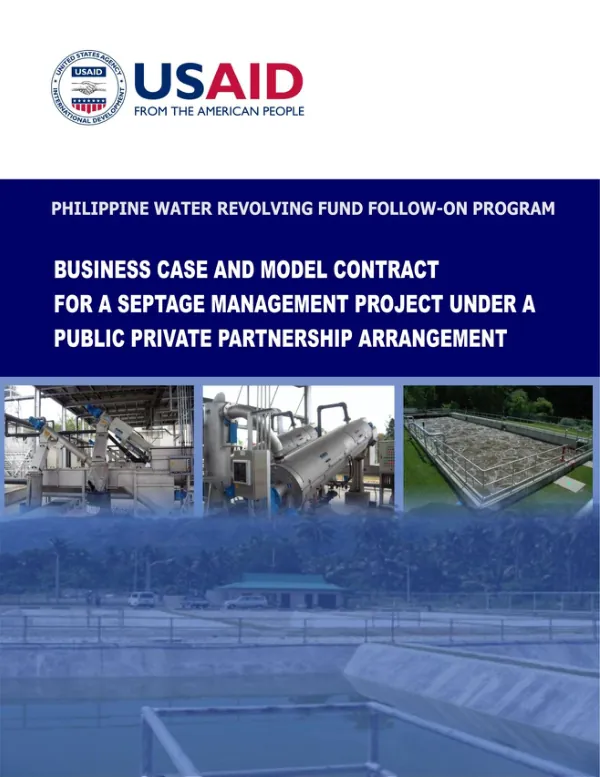
The Philippine Water Revolving Fund Follow-On Program Business Case and Model Contract for a Septage Management Project under a Public Private Partnership Arrangement was prepared by Development Alternatives, Inc.
2013 · 218 pages
Sign in to readA free account is required to download.
Abstract
in April 2013. The program aims to improve sanitation services in the Philippines through a public-private partnership (PPP) arrangement. The business case for the septage management project is based on the need to address the country's inadequate sanitation infrastructure, which poses significant health risks to the population. The project scope includes the construction and operation of a septage treatment plant, as well as the provision of services for the collection and treatment of septage from households and commercial establishments. The estimated cost of the project is PHP 1.4 billion, which includes capital costs, operation and maintenance (O&M) costs, and truck O&M costs. The project is expected to generate significant economic benefits, including the creation of jobs and the improvement of public health. The benefit-cost ratio (BCR) of the project is estimated to be 2.5, indicating that the project is economically viable. The project will be implemented through a build-operate-transfer (BOT) PPP arrangement, where the private sector partner will design, build, and operate the septage treatment plant for a period of 25 years. The payment structure for the project includes a fixed annual payment to the private sector partner, as well as a payment for the treatment of septage. The risk identification, assessment, and allocation process for the project has identified several risks, including general risks, pre-commissioning risks, and commissioning/project lifetime risks. The risk allocation process has allocated these risks between the government and the private sector partner. The institutional and legal aspects of the project include the approval process, which involves the Investment Coordination Committee (ICC) and the Pre-Qualification, Bids, and Awards Committee (PBAC). The project management plan includes market sounding, procurement, and contract review. The model contract for the septage management project includes provisions for the design, construction, and operation of the septage treatment plant, as well as the provision of services for the collection and treatment of septage. The contract also includes provisions for the payment structure, risk allocation, and dispute resolution. The septage management project is expected to improve sanitation services in the Philippines, reduce the risk of waterborne diseases, and generate significant economic benefits. The project is a good example of a PPP arrangement that can be used to address the country's infrastructure needs. The project will be implemented in several phases, including the design and construction of the septage treatment plant, the provision of services for the collection and treatment of septage, and the operation and maintenance of the plant. The project will be monitored and evaluated regularly to ensure that it is implemented in accordance with the approved project management plan. The septage management project is expected to have a significant impact on the environment, public health, and the economy. The project will reduce the risk of waterborne diseases, improve sanitation services, and generate significant economic benefits. The project is a good example of a PPP arrangement that can be used to address the country's infrastructure needs and improve the quality of life of its citizens.