TETRA TECH
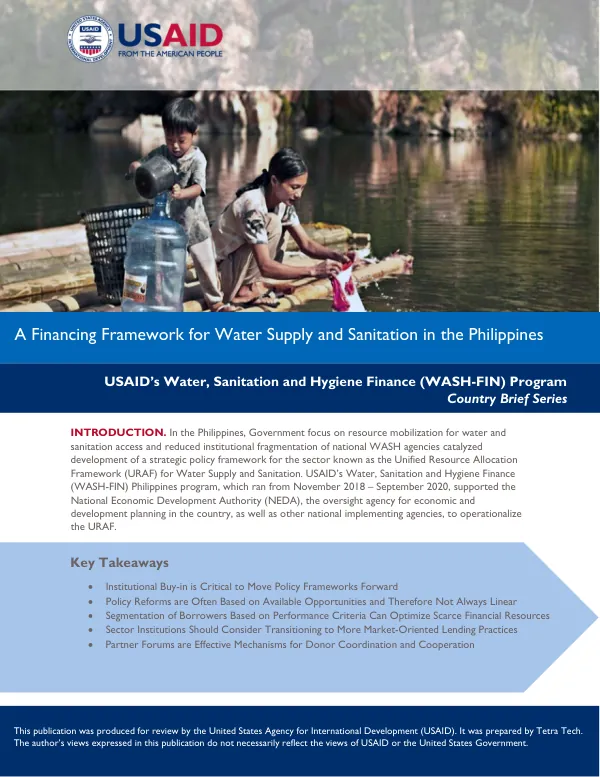
WASH-FIN Program Country Brief: Philippines
The Philippine Water and Sanitation Services (WSS) sector has no apex body, with more than 30 national and local government institutions involved in one or more aspects of WASH governance, service regulation, resource management, or economic regulation.
2021 · 12 pages
Sign in to readA free account is required to download.
Abstract
This institutional fragmentation has led to multiple agencies with potentially overlapping mandates involved in policy formulation, planning, and investment programming, resource and economic regulation, and standard setting. Despite the lack of a national framework or single accountable entity for the provision of sustainable services, the sector has made progress in achieving the Millennium Development Goals (MDGs) for water supply and sanitation. The Philippines achieved the MDGs for water supply and sanitation in 2015, with 88 percent of the population accessing safe water supply and 94 percent accessing basic sanitation services. As the country seeks to achieve universal WSS access by 2030 under the Sustainable Development Goals, it has codified a new set of strategies in the recent Philippine Water Supply and Sanitation Master Plan (PWSSMP). The PWSSMP estimates that achieving universal WSS coverage by 2030 and eliminating open defecation by 2022 will require an investment of about 1.3 trillion Philippine pesos (approximately US$ 27.3 billion). The sector has a diverse range of service providers, including Water Districts (WDs), Local Government Units (LGUs), Barangay Water Service Associations (BWSAs), Rural Water Service Associations (RWSAs), unnamed water service providers, and other service providers. WDs are autonomous government-owned and controlled corporations, authorized to provide water and sanitation services under Presidential Decree 198. BWSAs and RWSAs are loosely formed community associations that operate the facilities usually provided by the LGU. Unnamed water service providers serve at least 15 households and are not registered formally with any government agency. The Philippines has also implemented public-private partnerships (PPPs) to provide water and wastewater management services to Metro Manila under a concession contract. Two private companies, Manila Water Supply Company Inc. and Maynilad Water Services Inc., are providing water and wastewater management services to approximately 13 percent of the population. The PPPs will run until 2036. The Unified Resource Allocation Framework (URAF) for Water Supply and Sanitation was developed to support the National Economic Development Authority (NEDA) and other national implementing agencies in operationalizing the sector's policy framework. The URAF aims to optimize scarce financial resources by segmenting borrowers based on performance criteria. The framework also recommends transitioning to more market-oriented lending practices and considers the use of partner forums for donor coordination and cooperation. The WASH FIN program, which ran from November 2018 to September 2020, supported the operationalization of the URAF. The program's key takeaways include the importance of institutional buy-in, the non-linear nature of policy reforms, the need for segmentation of borrowers based on performance criteria, and the effectiveness of partner forums for donor coordination and cooperation.
Related documents