SAVE THE CHILDREN FUND
C-AME COMMUNICATION TOOL
The initiative for economic integration and reconciliation, Integrating ourselves, we construct our future, was implemented by Corporación El Minuto de Dios (CMD) in the border municipalities of Colombia and Venezuela.
2020 · 4 pages
Sign in to readA free account is required to download.
Abstract
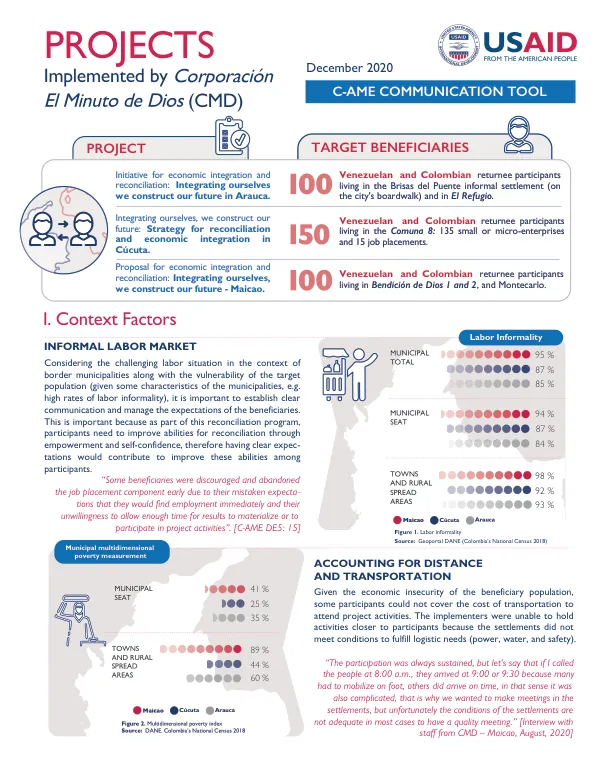
The project aimed to promote economic inclusion and reconciliation among Venezuelan and Colombian returnee participants living in informal settlements. The target beneficiaries included small and micro-enterprises, as well as individuals in need of job placement. The project faced several challenges, including labor informality, multidimensional poverty, and limited access to public services and infrastructure. According to the National Census 2018, labor informality rates were high in the target municipalities, with 87% of the population in Maicao and 85% in Cúcuta engaged in informal labor. The multidimensional poverty index also revealed that 95% of the population in Maicao and 92% in Cúcuta lived in poverty. The project's implementation was hindered by the precarious conditions of the settlements, where beneficiaries lived and operated their enterprises. The settlements lacked optimal sewage and drainage designs, leading to flooding during the rainy season, which made it difficult to carry out project activities. Additionally, the beneficiaries faced difficulties in assuming additional costs, such as transportation costs, which affected their participation in project activities. The project also addressed gender-based violence, which was a significant concern in the target municipalities. According to the National Public Health Surveillance System (SIVIGILA), the number of reported gender-based violence cases decreased during the COVID-19 pandemic, but migrant women faced particular challenges in accessing complaint, care, and rights protection services. The project's success was impacted by the high attrition rates among participants, which was attributed to the mismanagement of labor inclusion expectations. The project's implementers recommended that future initiatives consider alternative implementation sites, provide allowances for beneficiaries to afford transportation costs, and design communication strategies to manage participants' expectations regarding access to labor opportunities. The project also highlighted the importance of diversity in building initiatives for coexistence and reconciliation among ethnic, migrant, and host populations. The project included participants from diverse backgrounds, including Venezuelan migrants, Colombian returnees, displaced and vulnerable host populations, and individuals from the LGBTI community. The COVID-19 pandemic and the armed lockdown of the ELN in February 2020 also posed significant challenges to the project's implementation. The pandemic limited access to information technologies, while the lockdown concentrated the majority of the ELN's actions in Norte de Santander, leading to roadblocks, burning of vehicles, and threats that had a humanitarian impact in the target municipalities. Overall, the project's implementation was hindered by the challenging context in which it was implemented, including labor informality, multidimensional poverty, limited access to public services and infrastructure, and the COVID-19 pandemic. However, the project's findings and recommendations provide valuable insights for future initiatives aimed at promoting economic inclusion and reconciliation among vulnerable populations.
Related documents