THE WORLD FOOD PROGRAMME
School Feeding Response Activity (SFRA) Final Report FY2
The school feeding response activity (SFRA) in Colombia aimed to support the government's efforts to provide nutritional food sources for vulnerable Venezuelan children, Colombian returnee children, and host communities through a school feeding strategy.
2020 · 28 pages
Sign in to readA free account is required to download.
Abstract
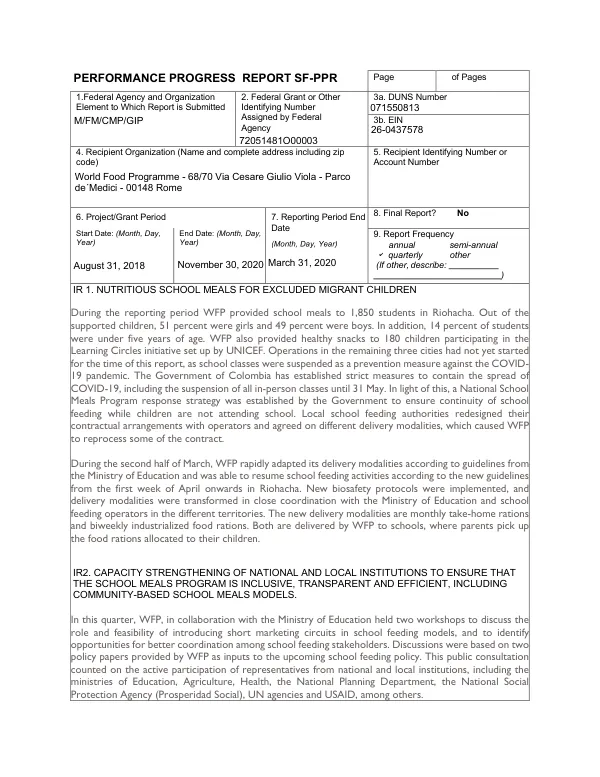
The activity also sought to strengthen the national school feeding program through new methodologies and/or strategies that would be piloted and transferred to the government of Colombia. The agreement was valid from August 31, 2018, to November 30, 2021. The SFRA was implemented by the World Food Programme (WFP) in collaboration with the Municipal Education Secretaries. The program provided school meals to students in 147 schools in four Colombian cities, including Riohacha, Cúcuta, Santa Marta, and Barranquilla. The program was successful in guaranteeing a balanced diet for students while at school and incentivizing sustained school attendance. In 2019, 92 percent of students who started the school year in WFP-supported schools finished it. During the COVID-19 crisis, the national government set restrictive measures to curb the spread of the virus, including the suspension of all in-person school activities. WFP quickly made operational and logistic changes to comply with the new set of rules and managed to support 12,236 children with take-home rations in Riohacha, Barranquilla, Santa Marta, and Cúcuta from April onwards. This increase in beneficiaries from Q1 to the rest of the year was related to efficiencies made in the operation of the program. The SFRA also aimed to strengthen national and local governments' capacities to implement an efficient school meals program. WFP developed seven key documents to inform and influence the future school feeding national policy. Two consultation workshops were held jointly with the Ministry of Education for the discussion of the policy documents produced by WFP. 43 representatives of national and local institutions related to the school feeding national policy participated. The SFRA also focused on encouraging community integration and preventing discrimination, xenophobia, and violence. A Social and Behavioural Change Communication (SBCC) strategy was developed and widely shared among key stakeholders. A baseline study was conducted by the University of Atlántico in all territories to observe integration dynamics between Venezuelan and Colombian students, identify gaps, and get their perceptions on the school feeding program. Based on the findings, a creative agency contracted by WFP developed the SBCC strategy aimed at preventing xenophobia and discrimination in WFP-supported schools. The strategy has been finalized and is ready to be implemented in Riohacha and Cúcuta in an initial phase. However, implementation requires a heavy component of on-site work at schools with children, parents, school staff, and the wider community, which has been limited by the COVID-19 crisis. Implementation is expected for the next school year, 2021, and arrangements are made so it can be implemented in a flexible way, including through virtual platforms. The SFRA received USD$ 4,988,075.58 in funds committed and USD$ 4,988,075.58 in funds obligated. The project duration was from August 30, 2018, to November 30, 2020. The key program partner was the Municipal Education Secretaries, and the reporting period was from September 2019 to September 2020.