USAID DEC
Complexity-Aware Monitoring and Evaluation Quarter Four FY2020 Report, July 1 – September 30, 2020
Sign inACDI/VOCA
Complexity-Aware Monitoring and Evaluation Quarter Four FY2020 Report, July 1 – September 30, 2020
The Complexity-Aware Monitoring and Evaluation (C-AME) project in Colombia began in 2020 with the objective of increasing the capacity for decision-making and adaptive management in complex environments through reliable and timely information and analysis.
2020 · 31 pages
Sign in to readA free account is required to download.
Abstract
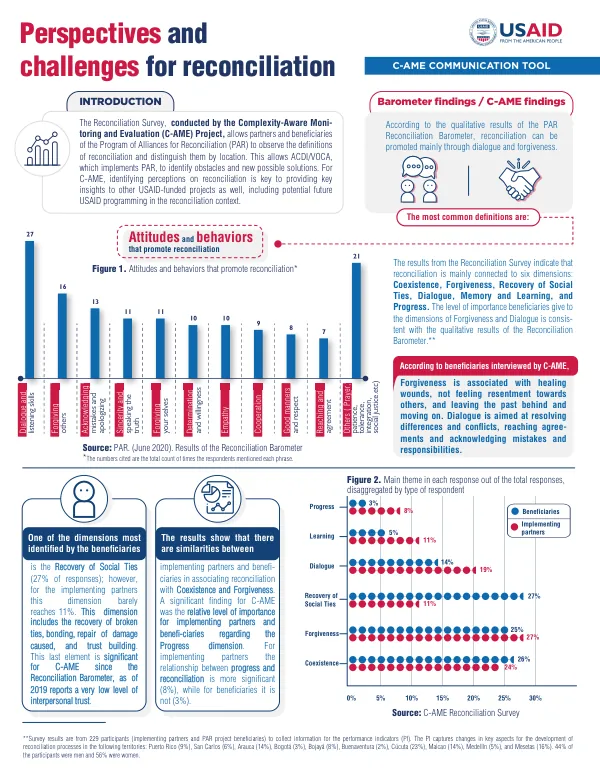
The project is part of the USAID Reconciliation Activity, implemented by ACDI/VOCA, and aims to contribute to the Program of Alliances for Reconciliation (PAR). In the fourth quarter of FY2020, C-AME's focus was on planning for the coming final fiscal year. The project prepared and submitted its Annual Work Plan (AWP) for FY2021, which includes the fifth iteration of the Developmental Evaluation (DE), the Performance Evaluation, monitoring activities, activities required for the C-AME's closing, and a final assessment. The final activity aims to carry out a comparative analysis of the context of nine selected municipalities, assuming USAID will approve a project extension request. During this period, the C-AME team continued with remote work due to the COVID-19 pandemic, allowing the team to complete planned technical and administrative activities while safeguarding the team and the broader community. The team conducted 123 data collection events for the fifth DE and for the monitoring activities required to report the C-AME indicator progress. The Performance Evaluation (PE) activity involved selecting 30 projects completed by PAR's national and local partners, clustering them by implementation progress and categorizing their main objective as falling into the three main evaluation components: communication and positive messages, private sector engagement, and sustainability of results. At the close of this period, the PE team conducted 20 out of 30 scheduled interviews with implementing partners and PAR representatives, reviewing documents and information found in indexes and campaign webpages. C-AME prepared two newsletters and one communication tool for quarter four, addressing lessons learned on C-AME's iteration, understanding social media's role in preventing xenophobia, and the progress of reconciliation in 10 municipalities. The project submitted the following contract deliverables in accordance with the timeframe established in the annual work plan FY2020: C-AME Annual Work Plan FY2021, Updated C-AME Plan for FY2021, Communication Tool – September 2020: Perspectives and challenges for reconciliation, Newsletter Vol. III, Issue 5 – July 2020: C-AME as a CLA approach, Newsletter Vol. III, Issue 6 – September 2020: Reconciliation and the Spread of Emotions – Analyzing Social Media via Automated Tools, Quarterly Report FY2020 Q3 (April 1, 2020 – June 30, 2020), and C-AME Transition Plan. The project's remote work strategy allowed C-AME to continue with planned activities despite mobility restrictions, enabling the team to complete the activities outlined in the FY2020 annual work plan. The project's focus on planning for the coming final fiscal year and its efforts to adapt to the COVID-19 pandemic demonstrate its commitment to increasing the capacity for decision-making and adaptive management in complex environments.