USAID DEC
Calabar Protocol: Sustainable Mangrove Management: An Additional Protocol to the Abidjan Convention
Sign inUSAID
Calabar Protocol: Sustainable Mangrove Management: An Additional Protocol to the Abidjan Convention
The Calabar Protocol on Sustainable Mangrove Management is an additional protocol to the Abidjan Convention, which aims to protect and conserve mangrove ecosystems in West, Central, and Southern Africa.
2019 · 2 pages
Sign in to readA free account is required to download.
Abstract
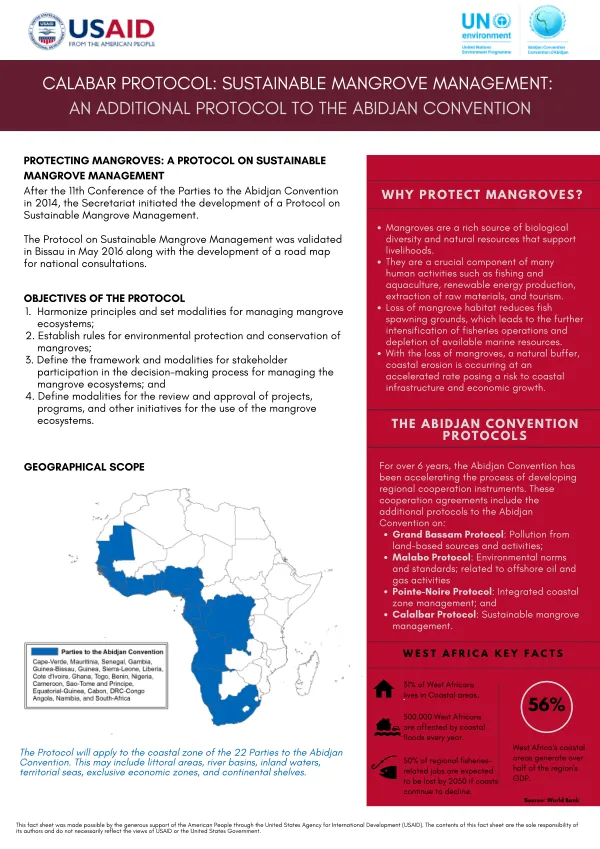
The protocol was validated in Bissau in May 2016, following the 11th Conference of the Parties to the Abidjan Convention in 2014. The Secretariat initiated the development of the protocol to harmonize principles and modalities for managing mangrove ecosystems, establish rules for environmental protection and conservation, and define the framework for stakeholder participation in decision-making processes. The protocol's geographical scope applies to the coastal zone of the 22 parties to the Abidjan Convention, including littoral areas, river basins, and inland waters. Mangroves are a rich source of biological diversity and natural resources that support livelihoods, and their loss can lead to reduced fish spawning grounds, coastal erosion, and depletion of marine resources. The protocol aims to address these challenges by promoting sustainable mangrove management practices, including strengthening the legal and institutional framework, restoration and rehabilitation of mangroves, and setting up sustainable funding mechanisms. The protocol's modalities for sustainable management of mangrove resources include strengthening the legal and institutional framework, restoration, rehabilitation, conservation, and rational utilization of mangroves, as well as setting up sustainable funding mechanisms and alternative means of livelihoods for communities bordering the mangroves. The protocol also emphasizes the importance of monitoring and evaluation, capitalization of traditional knowledge, promotion of best practices, participatory management of the mangrove ecosystem, and improvement of information and communication systems. To foster effective enforcement of the protocol, the contracting parties shall develop and adopt national and regional action plans and programs to ensure the sustainable use of mangroves, integrate mangrove management into relevant sectoral strategies, and adopt policies, specific legislative, and regulatory measures on sustainable mangrove management at the regional, national, and local levels. The parties shall also agree on common environmental priority programs, encourage the use of best available techniques and environmental practices, promote the application and facilitate access to and transfer of sustainable technologies, and encourage the involvement of all parties concerned with the management of mangroves. The West Africa Biodiversity and Climate Change (WA BiCC) program, funded by USAID, is testing the implementation of the protocol through site-based activities in the Sierra Leone Coastal Landscape complex and the Fresco Coastal Landscape of Cote d'Ivoire. The program aims to stimulate further interventions to upscale and encourage the signing, ratification, domestication, and wider application of the protocol in all contracting parties. The Abidjan Convention, signed in 1981, provides an overarching legal framework for all marine-related programs in West, Central, and Southern Africa, covering a marine area of just over 14,000 km.
Related documents