USAID
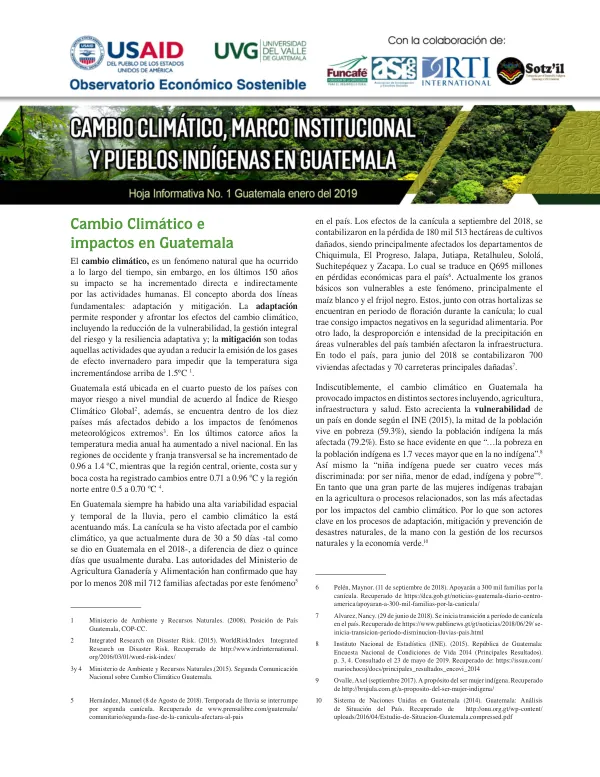
Cambio Climático, Marco Institucional y Pueblos Indígenas en Guatemala
The country of Guatemala is highly vulnerable to the impacts of climate change.
2019 · 4 pages
Sign in to readA free account is required to download.
Abstract
The phenomenon of climate change has been occurring naturally over time, but its impact has increased significantly over the past 150 years due to human activities. Climate change encompasses two fundamental lines: adaptation and mitigation. Adaptation involves responding and addressing the effects of climate change, including reducing vulnerability, managing risk, and promoting resilience. Mitigation refers to activities that help reduce greenhouse gas emissions to prevent the temperature from rising above 1.5°C. Guatemala is ranked fourth among countries with the highest risk worldwide according to the Global Climate Risk Index. The country is also among the top ten most affected by extreme weather events. Over the past 14 years, the average annual temperature has increased nationwide. The western region and the Transversal Strip have seen an increase of 0.96 to 1.4°C, while the central, eastern, southern coast, and Boca Costa regions have registered changes of 0.71 to 0.96°C. The northern region has experienced changes of 0.5 to 0.70°C. Climate change has exacerbated the spatial and temporal variability of rainfall in Guatemala. The dry season, or canícula, has been affected, lasting 30 to 50 days in 2018, compared to the usual 10 to 15 days. The Ministry of Agriculture, Livestock, and Food has confirmed that at least 208,712 families have been affected by this phenomenon. The impacts of the canícula in September 2018 resulted in the loss of 180,513 hectares of damaged crops, primarily affecting the departments of Chiquimula, El Progreso, Jalapa, Jutiapa, Retalhuleu, Sololá, Suchitepéquez, and Zacapa, translating to Q695 million in economic losses for the country. The country's staple crops, such as white corn and black beans, are vulnerable to this phenomenon, particularly during the canícula when they are in the flowering stage. This leads to negative impacts on food security. Additionally, the uneven and intense precipitation in vulnerable areas has affected infrastructure, with 700 homes and 70 main roads damaged nationwide by June 2018. The impacts of climate change have affected various sectors, including agriculture, infrastructure, and health, increasing the vulnerability of a country where half of the population lives in poverty (59.3%), with the indigenous population being the most affected (79.2%).