FINTRAC
Cambodia Market Systems Monitoring & Evaluation Review
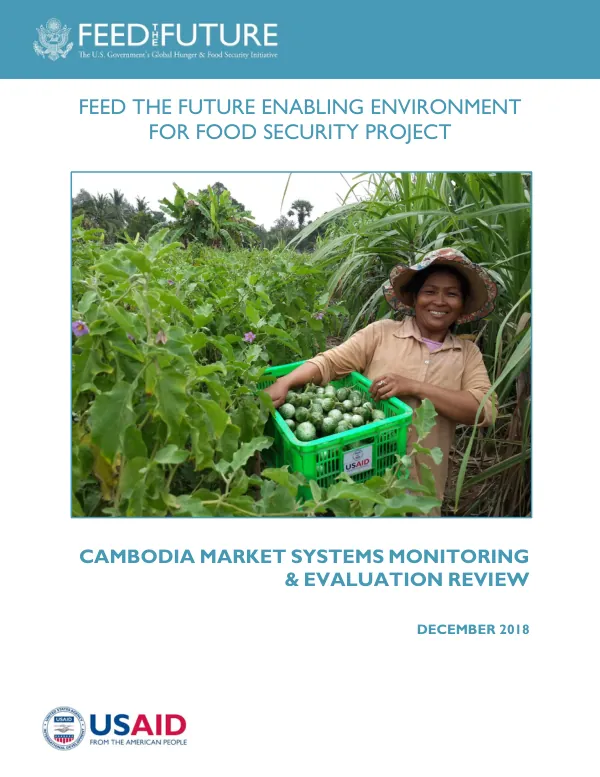
The Cambodia Market Systems Monitoring & Evaluation Review was conducted in December 2018 to provide USAID/Cambodia's Harvest II project with suggested learning questions and qualitative research tools.
2018 · 39 pages
Sign in to readA free account is required to download.
Abstract
The review aimed to help Harvest II assess its effectiveness in encouraging the development and spreading of improved practices among market partners and actors. The project, part of the US Government's Feed the Future initiative, focuses on building market linkages using a buyer-led approach and developing sustainable commercial partnerships between buyers and suppliers in the horticultural sector. The review found that the low margins for most horticultural produce in Cambodia constrained the extent to which rules and supports could be implemented in the sector, limiting the potential for efficient market systems development. However, opportunities for market system development exist in fruit and cashew nut production. Access to finance is relatively good in Cambodia, but remains a problem from the stakeholders' perspective. Corruption and bureaucracy are major issues from a commercial perspective, and costs of transport and power are a constraint to development. The buyer-led approach to market development does not lend itself to the assessment of systemic change, as it addresses the market one buyer at a time. Nevertheless, using the four stages of market development defined by the Springfield paradigm, it is possible to conduct a framework of learning questions and indicators that can form the basis of such an assessment. The review describes the framework and lists the information required to answer the learning questions. Outcome Mapping was ultimately selected as the most appropriate tool to supply the information necessary to assess changes in the market systems, as it fits well with the Growth Plan that is developed as part of each commercial partnership. The buyer, being the focal point of many Harvest II interventions, is also the most appropriate stakeholder to be canvassed on the state of the enabling environment. The Outcome Mapping tool to be incorporated as part of the Growth Plan exercise is described in detail, and a complete example is annexed to the report. The review also identified the need for additional qualitative research tools to assess the effectiveness of Harvest II in encouraging the development and spreading of improved practices among market partners and actors. The suggested learning questions and qualitative research tools are intended to inform the Feed the Future's market system monitoring, evaluation, and learning (MEL) approach. The review provides an overview of the enabling environment factors affecting market systems development in Cambodia, including the low margins for most horticultural produce, access to finance, corruption and bureaucracy, and costs of transport and power. The Harvest II project focuses on the horticultural sector with an initial emphasis on vegetable production and marketing, and an increasing trend toward higher-value commodities such as fruit and nuts. The project builds on years of USAID investment in the Cambodian provinces of Pursat, Battambang, Siem Reap, and Kampong Thom. The project's overarching purpose is to accelerate the growth of the commercial horticulture sector in the Zone of Influence (ZOI).