SOCIAL IMPACT, INC.
Cambodia Social Accountability Portfolio Performance Evaluation Brief
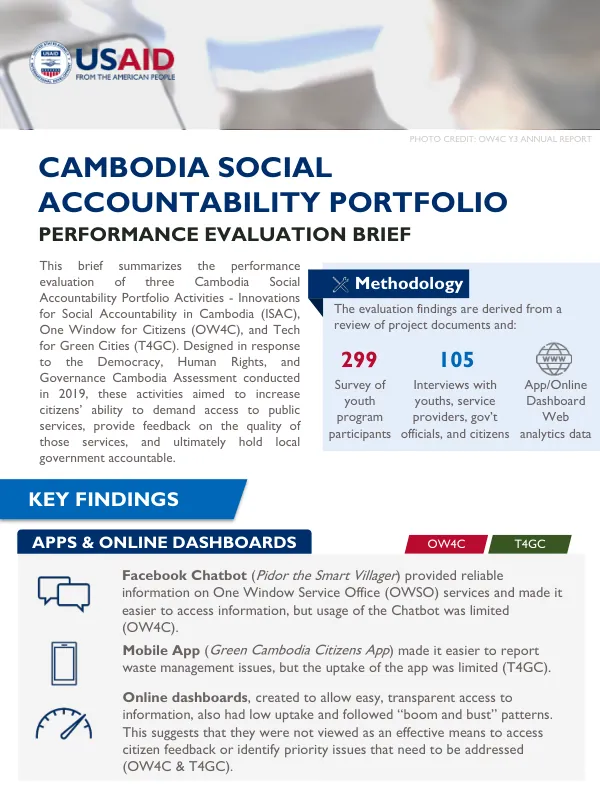
The Cambodia Social Accountability Portfolio Performance Evaluation Brief summarizes the performance evaluation of three Cambodia Social Accountability Portfolio Activities: Innovations for Social Accountability in Cambodia (ISAC), One Window for Citizens (OW4C), and Tech for Green Cities (T4GC).
2 pages
Sign in to readA free account is required to download.
Abstract
These activities were designed in response to the Democracy, Human Rights, and Governance Cambodia Assessment conducted in 2019. The primary objective of these activities was to increase citizens' ability to demand access to public services, provide feedback on the quality of those services, and ultimately hold local government accountable. The evaluation findings are derived from a review of project documents, a survey of youth program participants, 105 interviews with youths, service providers, government officials, and citizens, as well as app/online dashboard and web analytics data. Key findings indicate that while the Facebook Chatbot (Pidor the Smart Villager) provided reliable information on One Window Service Office (OWSO) services, its usage was limited. Similarly, the Mobile App (Green Cambodia Citizens App) made it easier to report waste management issues, but the uptake of the app was limited. Online dashboards, created to allow easy, transparent access to information, also had low uptake and followed "boom and bust" patterns. Community outreach efforts, including door-to-door (D2D) engagement and community meetings, were found to be effective in introducing technology and encouraging citizen participation. However, D2D requires clear planning and strategy to encourage citizen participation. The youth program led to increases in professional skills and participants felt encouraged and empowered, but there is mixed evidence that the program led to lasting impacts on participants' civic and political participation norms. The Community Scorecard Activity led to greater interaction and mutual understanding between citizens and service providers, but lack of clarity around the purpose and process made it less effective for some participants. Public forums increased citizens' access to information about OWSO services and engagement with officials, but some citizens were still apprehensive about their participation. Key recommendations include carefully considering the conditions when launching new tech tools, conducting outreach to ensure that the platform reaches a certain threshold number of users, and continuing to pursue youth programs, public forums, and community scorecards. Additionally, investing in more rigorous evidence of impact through experimental or quasi-experimental studies is recommended to confirm the impact of these programs.