USAID DEC
Capacity Building and Training Plan for Effective Public Procurement for Kyrgyzstani Taxpayers
Sign inDEVTECH SYSTEMS, INC.
Capacity Building and Training Plan for Effective Public Procurement for Kyrgyzstani Taxpayers
The Fiscal Accountability and Sustainable Trade (FAST) project supports rapid, sustainable, and equitable economic growth in USAID-assisted countries by enabling the Agency to bring a systems approach to addressing Public Financial Management (PFM), trade capacity building (TCB), macroeconomic planning and policies, and other economic governance issues.
2021 · 15 pages
Sign in to readA free account is required to download.
Abstract
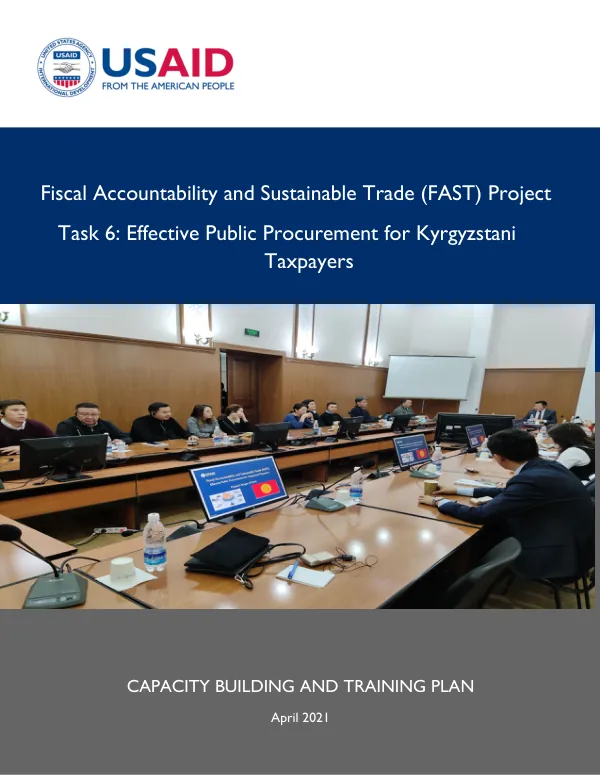
The project has two objectives: to increase efficiency and transparency of public procurement and to enable civic engagement and oversight over public procurement. Training and capacity building form a significant part of the project's technical assistance. The project will conduct training and capacity building workshops for staff from the Department of Public Procurement (DPP) and other procuring entities throughout the life of the project. These training activities are intended to improve the technical knowledge and understanding of officials working in public procurement and to increase their awareness of international best practices. The project will also conduct training and capacity building workshops for civil society organizations (CSOs) throughout the life of the project. These training sessions will help improve technical knowledge and understanding required for effective oversight and monitoring of public procurement. The project will mostly train the "trainers" so CSOs are able to widely implement training and capacity building programs, especially for members of the CSOs in Oblasts. The training plan has been developed to address specific training needs that were identified during the assessment phase of the FAST project. Training needs have been prioritized that are closely aligned with the main objectives of the FAST project and/or relate to specific activities in the project workplan. This includes procurement planning, needs analysis, market research toward optimal procurement strategies, and contract management. Trainings will be delivered face-to-face and will be held in an off-site classroom setting to allow for greater participation and ensure that there are a minimum of work-related disruptions. These trainings will combine presentations introducing topics and good practices, with group discussions that apply the concepts to the local circumstances. To facilitate open communication and encourage active participation, trainings will be facilitated by local FAST project staff. However, the project's international experts will be available at all times to provide the needed input and answer questions. A key feature of this Training Plan is the focus on "training of trainers" to ensure the capacity to train after the life of the FAST project. Most of the training courses included in the plan are either training of trainer courses, or courses delivered by those trainers but facilitated by the project's resources. The training materials for the courses will also be prepared as training packages that can be used by trainers for future training after the life of the FAST project. Participants at the courses in this Training Plan will be asked to complete a survey both at the beginning and at the end of each of the courses and then again six months after the completion of the course. This will help provide a better understanding of the existing capacity needs and will assist in monitoring the impact of the trainings. The Training Plan will be monitored through the overall FAST project Activity Monitoring, Evaluation, and Learning Plan (AMEL). There will be four training courses for staff of the DPP, the Ministry of Finance Training Centre, and procuring entities in FY 2021 and four in FY 2022. Of these, three will be in Bishkek and one in an Oblast in 2021, and one in Bishkek and three in Oblasts in 2022. The overview of these courses includes training on Strengthening Public Procurement Systems, International Best Practices, Procurement Cycle Management, Best Practices for Collaborative Procurement, Making Effective Use of e-Portal for Transparency and Efficiency of Public Procurement, and Procurement Cycle Management for Trainers.