USAID DEC
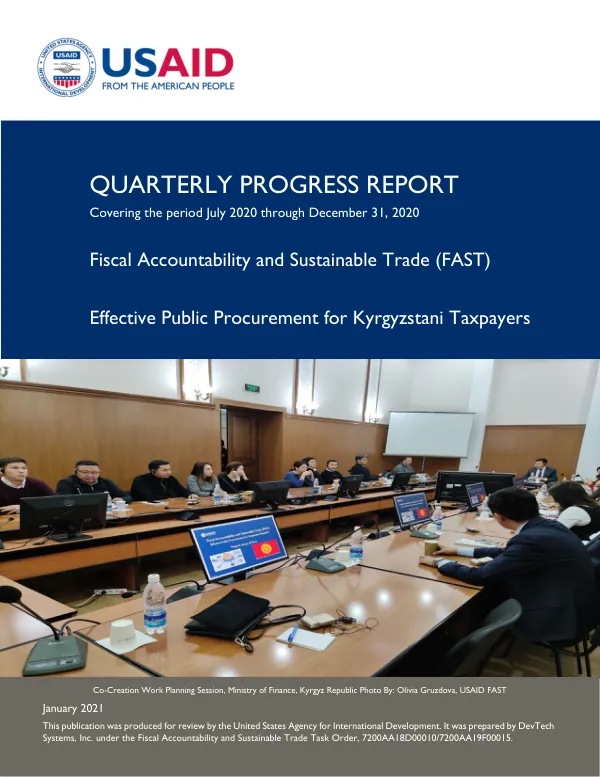
USAID Fiscal Accountability and Sustainable Trade, Quarterly Progress Report, January 2021
Sign inDEVTECH SYSTEMS, INC.
USAID Fiscal Accountability and Sustainable Trade, Quarterly Progress Report, January 2021
The Fiscal Accountability and Sustainable Trade (FAST) task order supports rapid, sustainable, and equitable economic growth in United States Agency for International Development (USAID) assisted countries by enabling USAID to bring a systems approach to addressing Public Financial Management (PFM), trade capacity building (TCB), macroeconomic planning and policies, and other economic governance issues.
2021 · 14 pages
Sign in to readA free account is required to download.
Abstract
The project aims to improve host-country capacity to mobilize revenue and provide public services, policy climate for investment, host-country ability to recover from and mitigate the impact of conflict, natural disasters, or fiscal crises, and host-country institutional capacity to identify, design, advocate, and implement better economic policies to enhance inclusive growth and gender equity. The project, "Effective Public Procurement for Kyrgyzstani Taxpayers," seeks to improve self-reliance of the Kyrgyz Republic by improving public procurement systems. The project has two objectives: to increase efficiency and transparency of public procurement and to enable civic engagement and oversight over the public procurement process. Technical assistance under the project is categorized into three broad categories: improving technical capacity of the Ministry of Finance (MoF) Department of Public Procurement (DPP) and other procurement entities, enabling civil society organizations (CSOs) to participate in public procurement tenders' oversight, and capacity building of DPP and procurement entities' staff and CSOs to efficiently and transparently conduct public procurement operations. The project began in July 2020, with the entire Kyrgyz Republic implementing shutdowns and social distancing due to COVID-19. DevTech successfully put together a team of local and international consultants to begin the project implementation remotely. The project operated entirely virtually to date, which had implications for the schedule of the planned activities for the last quarter of the fiscal year 2020. The team conducted consultations with representatives of the DPP of the MoF and CSOs to get a good understanding of the issues with the public procurement system. A scoping study was conducted in 2 stages: Stage 1, Identifying sources and collecting information, and Stage 2, Summarizing, analyzing, and reporting. The scoping study aimed to get a better understanding of the issues in the public procurement system that affect efficiency and transparency in the Kyrgyz Republic. The study was conducted in collaboration with the DPP and CSOs, and it provided a comprehensive overview of the public procurement system in the Kyrgyz Republic. The study identified key challenges and opportunities for improvement, which will inform the project's work plan and activities. Throughout the reporting period, FAST employed teleworking mechanisms while implementing social distancing. All FAST activities were conducted remotely, and despite the challenges presented by the teleworking set-up, FAST was able to work uninterrupted on the components. However, there were certain delays in the implementation of planned activities, due to this approach. Onsite work facilitated by travel would have been more efficient for project delivery. At this stage, FAST is performing smoothly with remote work and will be able to maintain the schedule for the work plan. The project's progress report reflects on the progress made since the project's start date through December 2020. The report highlights key activities that were undertaken during the reporting period, including the scoping study, consultations with the DPP and CSOs, and capacity building of DPP and procurement entities' staff and CSOs. The report also discusses some of the risks and challenges that the project faces, including COVID-19-related disruptions and delays in the implementation of planned activities.
Related documents