TETRA TECH
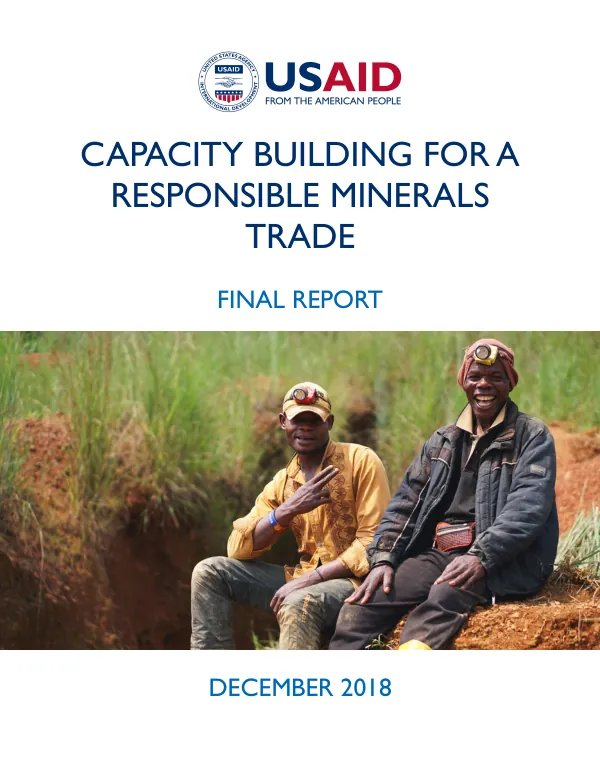
Capacity Building for a Responsible Minerals Trade: Final Report
Capacity Building for a Responsible Minerals Trade began in 2018 with funding from the United States Agency for International Development (USAID).
2018 · 61 pages
Sign in to readA free account is required to download.
Abstract
The project aimed to strengthen the capacity of institutions and systems in the Great Lakes region of Central Africa, particularly in the Democratic Republic of the Congo (DRC), to promote a responsible artisanal mining sector. The project consisted of four components: legal and policy reform, capacity building, responsible artisanal supply chains, and coordination and outreach. Component 1 focused on legal and policy reform, with the goal of improving the legal and policy framework for responsible minerals trade. At the regional level, the project worked with the International Conference on the Great Lakes Region (ICGLR) to develop a regional framework for responsible minerals trade. At the national level, the project supported the development of national policies and regulations for responsible minerals trade in the DRC. Component 2, capacity building, aimed to strengthen the capacity of institutions and systems in the DRC to promote responsible minerals trade. The project worked with mining cooperatives, artisanal miners, and DRC Mining Services to build their capacity to implement responsible mining practices. The project also conducted capacity assessments of partner organizations to identify areas for improvement. Component 3 focused on responsible artisanal supply chains, with a specific focus on tin, tantalum, tungsten, and gold. The project developed due diligence and traceability systems for these minerals, including the implementation of monitoring and tracing systems. The project also developed innovative tools and systems to support responsible artisanal mining practices. Component 4, coordination and outreach, aimed to strengthen collaboration among stakeholders to promote a responsible minerals trade. The project developed a virtual reality film, "Journey of Gold," to raise awareness about responsible minerals trade. The project also produced a film on responsible minerals trade and a film on women in mining. The project achieved several key outcomes, including the development of a regional framework for responsible minerals trade, the strengthening of institutions and systems in the DRC, and the implementation of due diligence and traceability systems for responsible artisanal supply chains. The project also demonstrated the effectiveness of virtual reality and film as tools for raising awareness about responsible minerals trade. The project's success was due in part to the collaboration and dedication of its partners, including USAID, the ICGLR, and the DRC government. The project also recognized the contributions of its subcontractors, including the Better Sourcing Program and GeoTraceability. The project's outcomes have the potential to contribute to a more responsible and sustainable minerals trade in the Great Lakes region of Central Africa. The project's impact was measured through a range of performance indicators, including the development of a regional framework for responsible minerals trade, the strengthening of institutions and systems in the DRC, and the implementation of due diligence and traceability systems for responsible artisanal supply chains. The project's outcomes have the potential to contribute to a more responsible and sustainable minerals trade in the Great Lakes region of Central Africa. The project's due diligence and traceability map provides a visual representation of the project's efforts to develop due diligence and traceability systems for responsible artisanal supply chains. The map highlights the project's focus on tin, tantalum, tungsten, and gold, and demonstrates the project's commitment to promoting responsible minerals trade in the Great Lakes region of Central Africa.