TETRA TECH
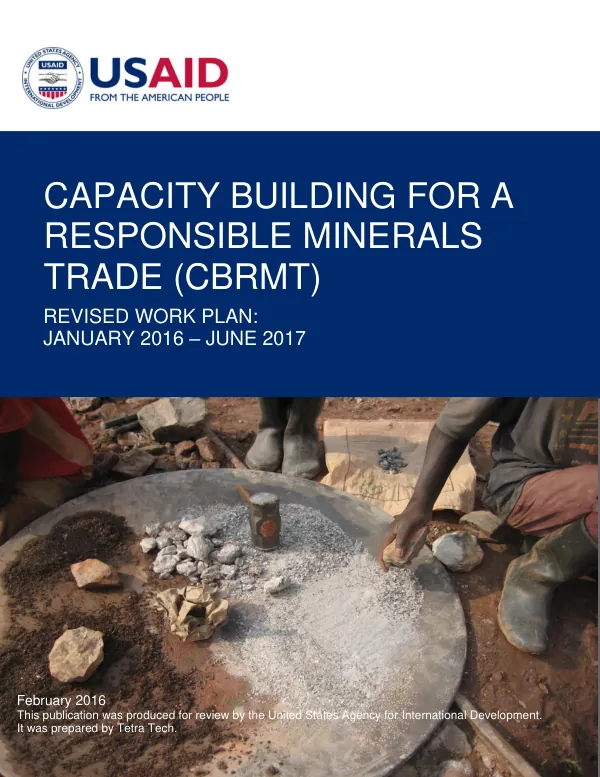
Capacity Building for a Responsible Minerals Trade Revised Work Plan
Capacity Building for a Responsible Minerals Trade (CBRMT) is a program aimed at improving the management and trade of minerals in the Great Lakes Region.
2016 · 60 pages
Sign in to readA free account is required to download.
Abstract
The program is implemented by Tetra Tech, in partnership with the United States Agency for International Development (USAID), and is funded by USAID Contract No. AID-OAA-I-12-00032/AID-660-TO-14-00002. The program's main objective is to improve the capacity of key actors in the minerals trade, including the Ministry of Mines, the International Conference for the Great Lakes Region (ICGLR), and other stakeholders. This is achieved through a range of activities, including technical assistance, training, and capacity building. One of the key areas of focus for the program is the development of conflict-free mineral traceability systems. The program has updated the 3T scaling plan, which aims to increase the use of conflict-free minerals in the region. The program has also scaled up gold production, with a focus on improving the management and trade of gold in the region. The program has also provided technical assistance to the ICGLR to improve its organizational and financial management capacity. This includes a needs assessment of the ICGLR's organizational and financial management capacity, as well as focused technical assistance to improve the ICGLR's management and financial systems. In addition, the program has improved the ICGLR's capacity to monitor and audit conflict-free supply chains. This includes operationalizing at least six Independent Mineral Chain Auditor (IMCA) investigations, as well as providing technical assistance to increase the effectiveness, efficiency, and sustainability of the Regional Certification Mechanism (RCM). The program has also promoted collaboration and coordination among stakeholders in the minerals trade. This includes partnerships with organizations such as the Alliance for Responsible Mining, the Conflict Free Smelter Initiative, and the Public-Private Alliance for Responsible Minerals Trade. The program has also implemented a range of cross-cutting activities, including gender mainstreaming, monitoring and evaluation, and environmental impact and mitigation. These activities aim to ensure that the program's activities are sustainable and have a positive impact on the environment and local communities. The program's management and operations are overseen by an office located in the Great Lakes Region. The office is responsible for implementing the program's activities, as well as providing technical assistance and support to stakeholders in the minerals trade. Overall, the CBRMT program is an important initiative aimed at improving the management and trade of minerals in the Great Lakes Region. The program's activities are focused on improving the capacity of key actors in the minerals trade, promoting conflict-free mineral production and trade, and ensuring that the program's activities are sustainable and have a positive impact on the environment and local communities. The program's revised work plan, which covers the period from January 2016 to June 2017, outlines the program's objectives, activities, and expected outcomes. The work plan is based on a thorough analysis of the program's needs and priorities, and is designed to ensure that the program's activities are aligned with the program's overall objectives. The program's revised work plan includes a range of activities aimed at improving the capacity of key actors in the minerals trade. These activities include technical assistance, training, and capacity building, as well as the development of conflict-free mineral traceability systems and the promotion of collaboration and coordination among stakeholders in the minerals trade. The program's revised work plan also includes a range of cross-cutting activities aimed at ensuring that the program's activities are sustainable and have a positive impact on the environment and local communities. These activities include gender mainstreaming, monitoring and evaluation, and environmental impact and mitigation. Overall, the CBRMT program's revised work plan is an important document that outlines the program's objectives, activities, and expected outcomes. The work plan is designed to ensure that the program's activities are aligned with the program's overall objectives, and that the program's activities are sustainable and have a positive impact on the environment and local communities.