USAID DEC
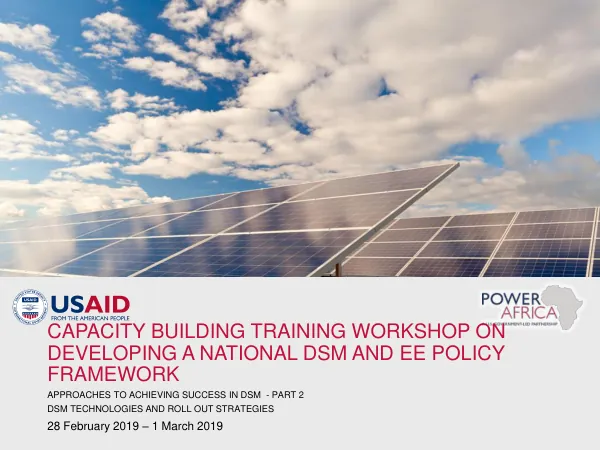
Capacity Building Training Workshop on Developing a National DSM and EE Policy Framework
Sign inUSAID
Capacity Building Training Workshop on Developing a National DSM and EE Policy Framework
Capacity building training workshops on developing a national Demand Side Management (DSM) and Energy Efficiency (EE) policy framework are crucial for achieving success in DSM.
2019 · 34 pages
Sign in to readA free account is required to download.
Abstract
Approaches to achieving success in DSM are multifaceted and involve various strategies for DSM based on customers. These strategies include energy reduction programs, load management programs, and load control measures. Energy reduction programs aim to reduce demand through more efficient processes, buildings, or equipment. Load management programs, on the other hand, change the load pattern and encourage less demand at peak times and peak rates. Load control measures involve switching loads on or off, often remotely, by the utility. Tariff incentives or penalties, such as time-of-use pricing and power factor penalties, are also used to influence energy usage. The roles and obligations of others in the supply industry are critical for a successful DSM program. Utilities must be enabled to undertake efficiency implementation, and downstream utilities are better positioned to deliver energy efficiency. Institutional responsibilities must be apportioned to governmental and regulatory actors to enable energy efficiency. Implementation plan strategies that align with the overall national strategy are essential for achieving success in DSM. These strategies involve treating energy efficiency as equivalent to a supply-side resource, establishing conditions that enable utilities, and enabling downstream utilities to deliver energy efficiency. Load management targeting options, such as load levelling, load control, and tariff incentives or penalties, are also used to achieve DSM goals. The SADC region has vast opportunities for energy savings through more-efficient technologies, fuel switching, change of habits, and improved processes. The region's current peak load needs and energy imports highlight the need for DSM measures. The DSM challenge lies in achieving real impact on the evening peak, and various strategies are being explored to address this challenge. Leading practices for DSM measures include treating energy efficiency as equivalent to a supply-side resource, enabling utilities to undertake efficiency implementation, and apportioning institutional responsibilities to governmental and regulatory actors. Energy efficiency and demand-side management strategies, such as CFL exchange, energy-saving awareness, demand market participation, and time-of-use tariff, are being implemented in various SADC countries. The SADC region has made significant progress in implementing DSM measures, with several countries actively participating in DSM programs since 2015. The region's renewable energy and energy efficiency status report highlights the importance of DSM in achieving energy savings and reducing energy imports.
Related documents