USAID
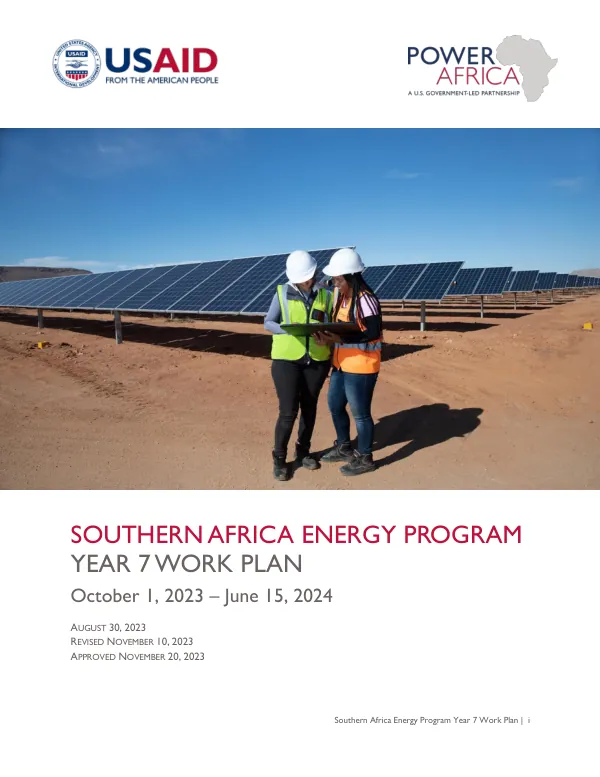
Southern Africa Energy Program Year 7 Work Plan
The Southern Africa Energy Program (SAEP) is a regional initiative aimed at promoting energy development and access in the Southern African region.
2023 · 82 pages
Sign in to readA free account is required to download.
Abstract
The program is implemented by the United States Agency for International Development (USAID) and is supported by various international partners. The SAEP Year 7 Work Plan outlines the program's objectives, activities, and expected outcomes for the period from October 1, 2023, to June 15, 2024. The SAEP Year 7 Work Plan is structured around five key outcomes, which are designed to address the region's energy challenges and promote sustainable energy development. Outcome 1 focuses on improving regulation, planning, and procurement for energy, while Outcome 2 aims to enhance the commercial viability of utilities. Outcome 3 seeks to promote regional harmonization and cross-border trade, while Outcome 4 focuses on demonstrating renewable energy and energy efficiency technologies and practices locally. Outcome 5 aims to increase human and institutional capacity in the energy sector. The SAEP Year 7 Work Plan outlines a range of activities and interventions to achieve these outcomes. These include technical assistance, capacity building, and infrastructure development projects. The program also places a strong emphasis on monitoring and evaluation, with a range of indicators and metrics used to track progress and measure success. One of the key areas of focus for the SAEP Year 7 Work Plan is the promotion of renewable energy and energy efficiency technologies. The program aims to support the development of solar, wind, and other forms of renewable energy, as well as energy efficiency measures such as energy-efficient lighting and appliances. This is seen as critical to reducing the region's dependence on fossil fuels and mitigating the impacts of climate change. The SAEP Year 7 Work Plan also places a strong emphasis on regional harmonization and cross-border trade. The program aims to support the development of regional energy markets and facilitate the exchange of energy goods and services across borders. This is seen as critical to promoting economic integration and reducing energy poverty in the region. In terms of implementation, the SAEP Year 7 Work Plan outlines a range of activities and interventions to be undertaken by the program's implementing partners. These include technical assistance, capacity building, and infrastructure development projects, as well as monitoring and evaluation activities. The program also places a strong emphasis on stakeholder engagement and communication, with a range of activities designed to engage with local communities, governments, and other stakeholders. Overall, the SAEP Year 7 Work Plan provides a comprehensive framework for promoting energy development and access in the Southern African region. The program's focus on renewable energy, energy efficiency, and regional harmonization is seen as critical to reducing energy poverty and promoting sustainable energy development in the region.