USAID DEC
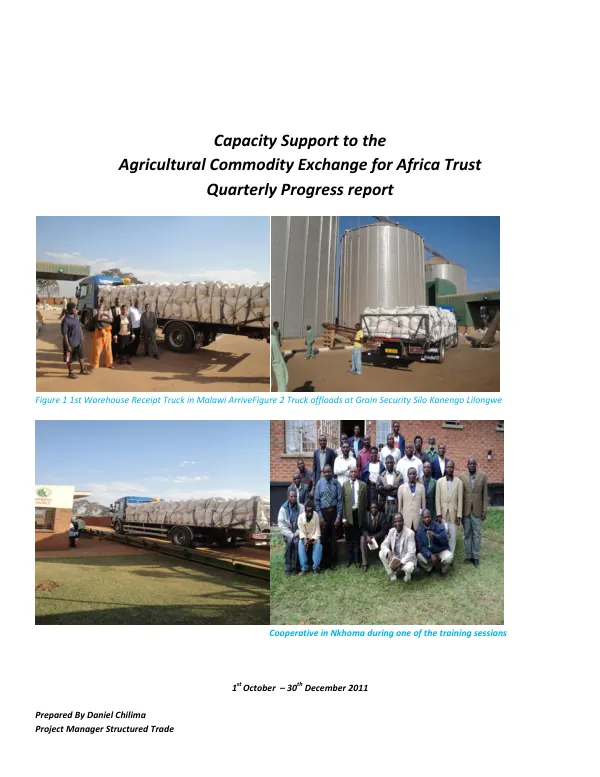
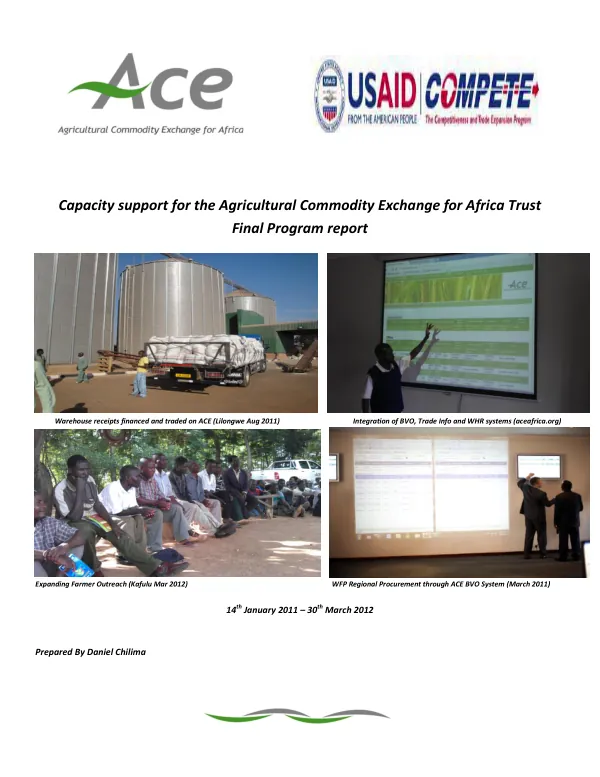
Capacity Support to the Agricultural Commodity Exchange for Africa Trust January 2012 Progress report
Sign inCHEMONICS
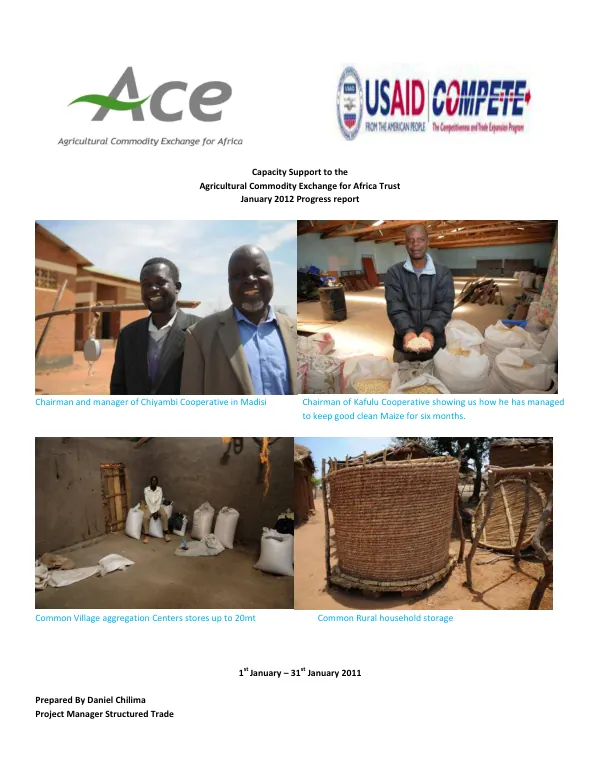
Capacity Support to the Agricultural Commodity Exchange for Africa Trust January 2012 Progress report
The Agricultural Commodity Exchange for Africa (ACE) was established in July 2004 with a grant from USAID through NASFAM to bring order to the market place.
2012 · 9 pages
Sign in to readA free account is required to download.
Abstract
ACE has operated a live exchange trading platform since late October 2006 and has facilitated trade of 81,812.83mt of commodities worth USD 25,937,940.14 across the exchange. ACE received bridging funding from COMPETE to set up necessary processes and baselines to generate agricultural commodity market access, encourage transparency, and facilitate commodity price discovery. This funding also enabled ACE to stay operative and attract more commercial warehouse operators to maximize registered warehouse storage. The Reserve Bank of Malawi (RBM) has shown interest in the Warehouse Receipt System (WRS) due to its potential to incentivize and promote export, and has deployed an Export Development Fund (EDF) to increase Malawi's export and foreign currency earnings. The WRS has three incentives for exporters: competitive financing, penalty-free export, and 100% foreign currency benefit. The commercial sector has shown interest in the WRS, with most commercial traders committing to register 114,400 MT storage capacity. ACE is working towards bringing the WRS closer to rural areas, with three rural sites for warehouse receipt system to be completed early March. The ACE trade system has three components: normal bid/offer matching functionality, Bid Volume Only (BVO) auction system, and warehouse receipt system. The system is integrated and working on the same database, with the warehouse receipt registry keeping control of WR ownership and outstanding storage costs and financing. The basic functions of the system, such as issuing a WR, financing a WR, and trading a WR, are complete and working. However, more advanced functions, such as splitting a WR or merging two receipts into one, still need to be done manually. Different users have access to the WRS registry, including storage operators, banks, and traders. The storage operators can issue receipts, request financing, and trade receipts on ACE, while the banks can approve and process finance requests and monitor their risk exposure. The WRS has a built-in mechanism to prevent loss of collateral, with the banks determining a level of notification and level of recovery. As of February 2012, ACE has facilitated trade of various commodities, with a total of 60.00mt traded in 2006, increasing to 14,505.90mt in 2009. The trade summary shows a steady increase in trade volumes over the years, with a total of 81,812.83mt traded across the exchange. ACE is working towards increasing its capacity to undertake increasing procurement demands and developing software applications necessary to fully harness the benefits of WFP and other commercial operators. The COMPETE funds continue to enhance ACE's capacity to undertake increasing procurement demands and develop the software applications necessary to fully harness the benefits of WFP and other commercial operators. The Reserve Bank of Malawi (RBM) has deployed an Export Development Fund (EDF) to increase Malawi's export and foreign currency earnings. The EDF has a capital of 80 billion Malawi Kwacha and will provide competitive financing to exporters, with the level of interest rates to be determined. The EDF will also provide a penalty-free export facility, with the foreign currency generated by export of a WR financed under the EDF to benefit the exporter.