USAID
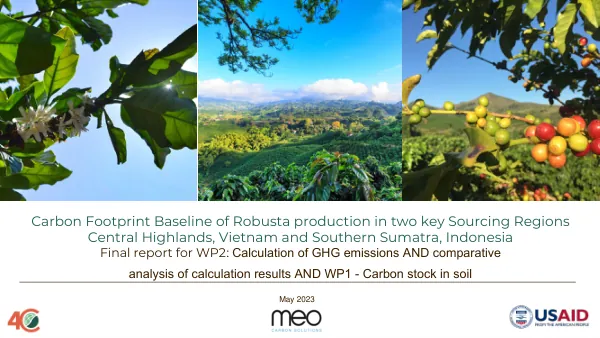
Carbon Footprint Baseline of Robusta production in two key Sourcing Regions
The carbon footprint baseline of Robusta production in two key sourcing regions, Central Highlands, Vietnam, and Southern Sumatra, Indonesia, was assessed in this report.
2023 · 327 pages
Sign in to readA free account is required to download.
Abstract
The study aimed to calculate greenhouse gas (GHG) emissions and compare the results with those obtained using the Cool Farm Tool (CFT). The assessment area in Vietnam covered a total of 44,838,624 km2, with 2,539 farms located in the provinces of Gia Lai, Đắk Lắk, Đắk Nông, and Lâm Đồng. In Indonesia, the assessment area spanned 140,096,345 km2, with 2,045 farms located in the provinces of Bengkulu, Sumatera Selatan, and Lampung. GHG emission calculations were performed using the 4C Carbon Footprint Add-On and the CFT. The results showed significant differences between the two tools, particularly in the calculation of land use change (LUC) emissions. The 4C methodology for calculating LUC emissions does not include a default or minimum percentage of LUC, and emissions from LUC should be considered in coffee GHG calculations if LUC has been detected and data is available. The study found that the 4C Carbon Footprint Add-On produced higher GHG emission values than the CFT, particularly in the Central Highlands region of Vietnam. In Southern Sumatra, Indonesia, the 4C results were lower than those obtained using the CFT. The differences in results were attributed to methodological differences between the two tools, particularly in the calculation of LUC emissions. The assessment of carbon stocks in soil was performed using the IPCC approach and GIS mapping tools. The study identified two main differences between the 4C and CFT methodologies: the use of the latest version of the IPCC from 2019, including carbon in vegetation (Cveg) and dead organic matter (DOM), and the use of higher-resolution data from partner GRAS and MCS for soil organic carbon (SOC) values. The results of the GHG emission calculations are presented in the report, with values ranging from 1.55 to 7.81 kg CO2e/kg GBE for the Central Highlands region of Vietnam and from 1.06 to 3.04 kg CO2e/kg GBE for the Southern Sumatra region of Indonesia. The report highlights the importance of considering LUC emissions in coffee GHG calculations and the need for careful interpretation of the results due to methodological differences between the two tools.