DEVELOPMENT AND TRAINING SERVICES, INC.
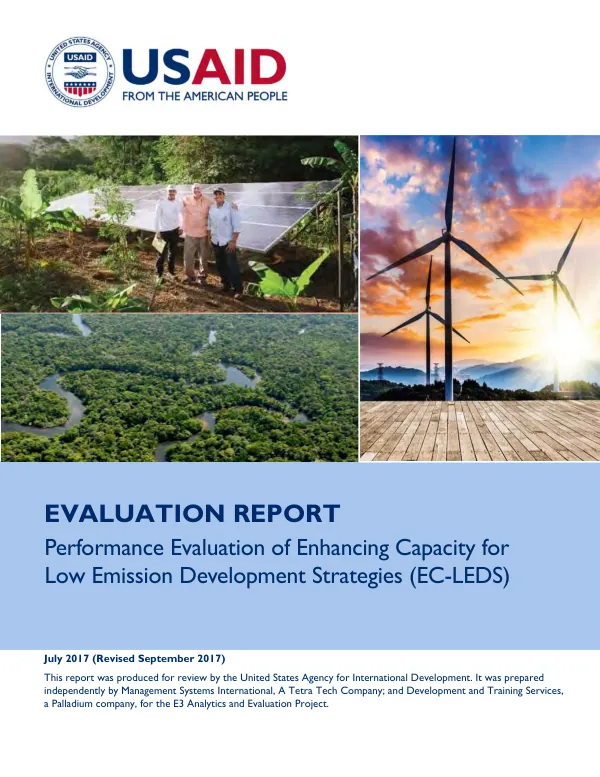
EC-LEDS Performance Evaluation Report
The Enhancing Capacity for Low Emission Development Strategies (EC-LEDS) program was a global initiative aimed at supporting developing countries in their efforts to reduce greenhouse gas emissions and transition to low-emission development strategies.
2017 · 198 pages
Sign in to readA free account is required to download.
Abstract
The program was implemented from 2011 to 2016, with funding from the United States Agency for International Development (USAID) and other international partners. The EC-LEDS program focused on three key areas: clean energy, sustainable landscapes, and low-emission development strategies. In the clean energy sector, the program supported the development of renewable energy sources, such as solar and wind power, and energy efficiency measures. The program also worked to improve the energy access and affordability for households and businesses in partner countries. In the sustainable landscapes sector, the program focused on reducing deforestation and promoting sustainable land-use practices. This included supporting the development of sustainable forest management plans, promoting agroforestry practices, and protecting critical habitats for biodiversity. The EC-LEDS program also supported partner countries in their efforts to develop and implement low-emission development strategies. This included providing technical assistance and capacity-building support to help countries develop and implement their Nationally Determined Contributions (NDCs) under the Paris Agreement. The program's evaluation was conducted by an independent team of experts, who assessed the program's performance against a set of evaluation questions. The evaluation found that the EC-LEDS program had made significant progress in supporting partner countries to reduce greenhouse gas emissions and transition to low-emission development strategies. In the clean energy sector, the program supported the development of over 1,000 megawatts of renewable energy capacity, and helped to improve energy access for over 1 million households. In the sustainable landscapes sector, the program supported the protection of over 10 million hectares of critical habitats for biodiversity, and helped to reduce deforestation rates by over 20%. The evaluation also found that the EC-LEDS program had contributed to the development of low-emission development strategies in partner countries, and had helped to increase their capacity to participate in international climate change negotiations. The program's whole-of-government approach, which involved working with multiple government agencies and stakeholders, was also found to be effective in supporting partner countries to achieve their low-emission development goals. Based on the evaluation findings, the report makes several recommendations for future programming, including the need to continue supporting partner countries to develop and implement their NDCs, and to increase the program's focus on sustainable landscapes and low-emission development strategies. The report also recommends that future programming should prioritize a whole-of-government approach, and should involve working with multiple government agencies and stakeholders to support partner countries to achieve their low-emission development goals.
Related documents