USAID. MISSION TO DOMINICAN REPUBLIC
CARE rural water
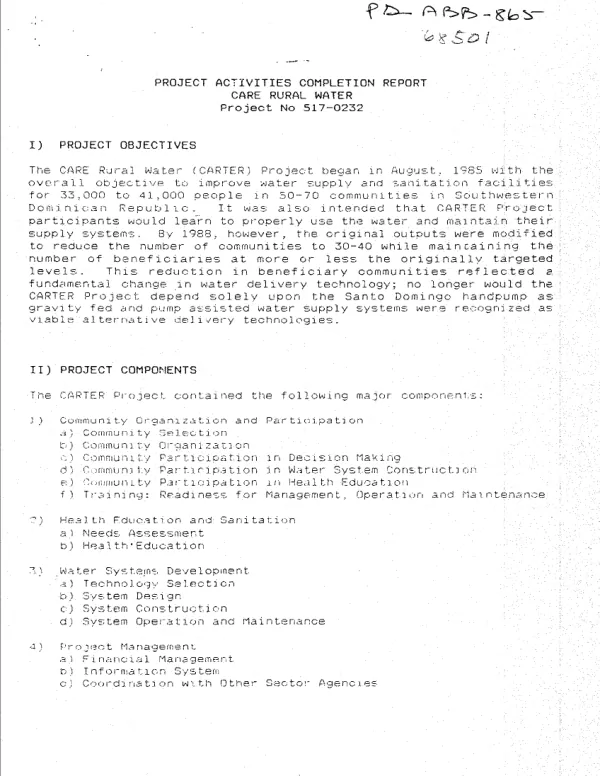
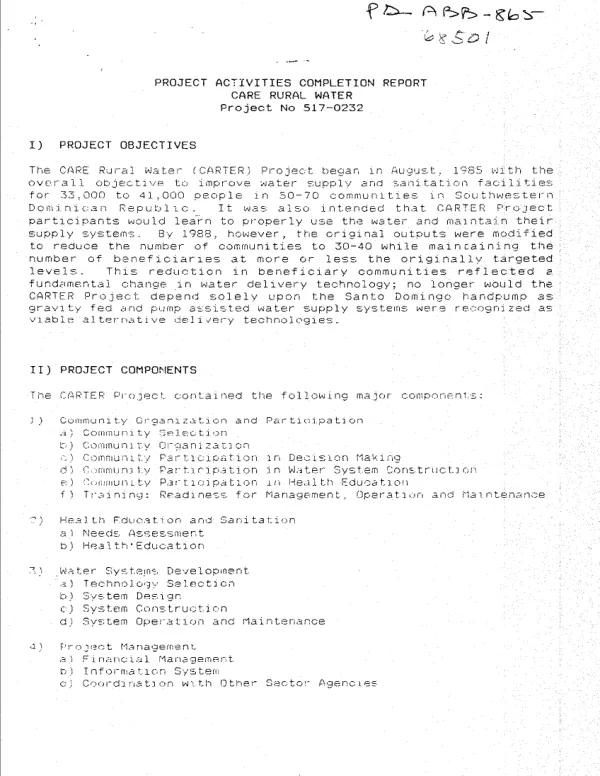
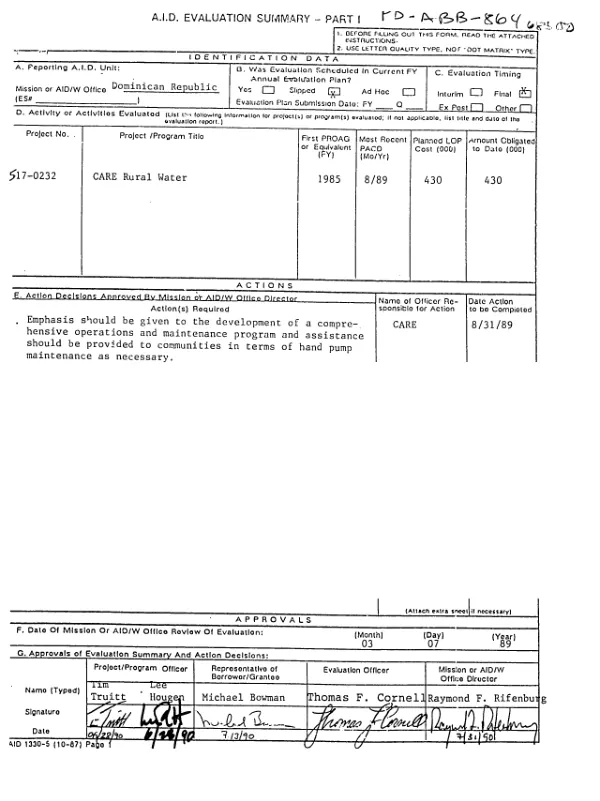
Summarizes final evaluation (PD-AAZ-811) of an OPG to CARE to construct water supply systems and provide related health education to communities in southwestern Dominican Republic.
1990
Sign in to readA free account is required to download.
Abstract
The evaluation covered the period FY85-2/89. A major strength of the project was the decision to expand the types of technology provided to include gravity flow and photovoltaic systems in addition to handpumps. This change allowed participants a choice of technology and had a positive effect on performance at all levels. Efforts to improve water supply were more successful in communities which selected the piped water distribution systems rather than handpumps due to a high level of communal interest, a perception of community ownership, and a more adequate operation and maintenance program. Project management was generally satisfactory and, after initial difficulties with recruitment and performance, the field staff became one of the project"s greatest assets. Water committees are functioning and water system caretakers received some training. Most committees are active in overseeing the operation of the water systems and collecting funds for maintenance. Residents are aware of the role and purpose of the committees and the foundation is established for community-based maintenance programs. In many cases, however, the communities will not be able to perform all maintenance tasks. Although the project promoted latrines, only two were constructed, suggesting that promotion alone is not enough in low-income areas. While the project health promoters made some progress in improving health practices, TA and training materials for health education as well as the strategy for health education were inadequate. Several lessons were learned. (1) Poor project designs can be overcome by effective implementation strategies. (2) Water projects should allocate approximately 20% of their resources to health education to ensure lasting effects. (3) A sense of teamwork and interdependence among project health, engineering, and support personnel is necessary for successful planning and problem-solving. (4) Sanitation efforts require the provision of training, equipment, and subsidized latrine construction materials in addition to promotional activities. (5) Potential for project success and sustainability is considerable when community members are involved in the selection and implementation of water systems. (6) The Southwestern region is a difficult area for water development because of natural resources limitation and lower availability of services. See also abstract of PD-AAZ-811.