CARE
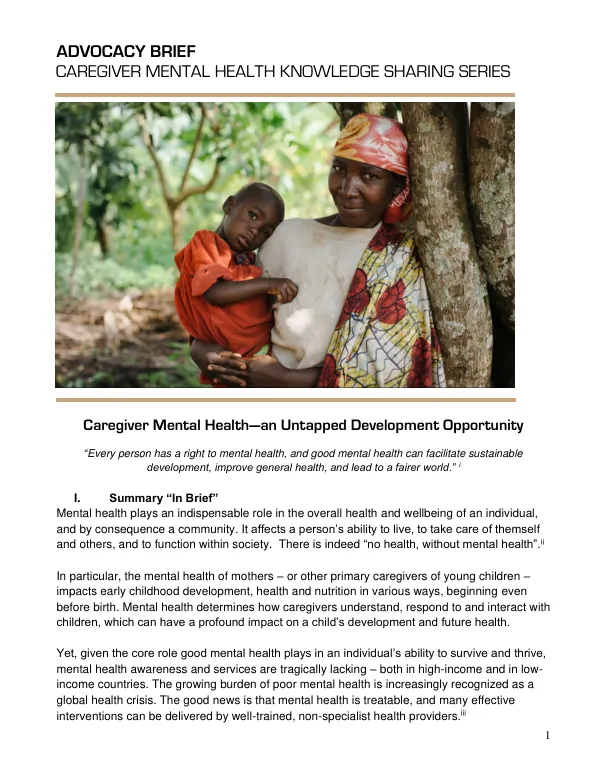
Caregiver Mental Health—an Untapped Development Opportunity
Caregiver Mental Health—an Untapped Development Opportunity Mental health plays a crucial role in the overall health and wellbeing of an individual, and by consequence, a community.
2021 · 7 pages
Sign in to readA free account is required to download.
Abstract
It affects a person's ability to live, take care of themselves and others, and function within society. The mental health of mothers or other primary caregivers of young children impacts early childhood development, health, and nutrition in various ways, beginning even before birth. Mental health determines how caregivers understand, respond to, and interact with children, which can have a profound impact on a child's development and future health. The World Health Organization (WHO) articulates mental health as a state of well-being in which an individual realizes their own abilities, can cope with the normal stresses of life, can work productively, and is able to make a contribution to their community. Mental disorders comprise a broad range of problems, with varying symptoms. However, they are generally characterized by a combination of abnormal thoughts, emotions, behavior, and relationships with others. Mental illness includes mental, neurological, and substance use disorders, suicide risk, and associated psychosocial, cognitive, and intellectual disabilities. Caregiver mental health specifically refers to the mental wellbeing of any adult(s) who are in a primary caretaking role for young children. Caregivers are typically mothers and fathers, but also include adoptive parents, grandparents, relatives, or other adults who most closely care and assume responsibility for the child. Young children are largely dependent on their caregiver for their wellbeing. A caregiver's own wellbeing will also have a direct impact on the child. Mental health issues most commonly affecting caregivers are depression and anxiety. Globally, nearly one billion people are living with a mental disorder. In contexts characterized by fragility, conflicts, and violence, the number of people affected by mental health rises to approximately one in five people (22%). Worldwide, 15-23% of children live with a parent with a mental illness. Children living with a parent with a mental health condition are at an increased risk of cognitive, emotional, and physical development. Yet, comparatively few people around the world have access to quality mental health services. In low- and middle-income countries, more than 75% of people with mental, neurological, and substance use disorders never receive treatment for their condition. Primary caregivers of young children, and women in the perinatal and postpartum period in particular, are disproportionately at risk for mental illness. Pregnant women and women who have recently given birth suffer a higher degree of mental illnesses compared to other women. In low-income countries, it is estimated that nearly one in six women (16%) will suffer from a mental illness during pregnancy and one in five women (20%) will suffer from a mental illness after childbirth. Depression and anxiety tend to be most severe in communities that experience poverty, conflict, or humanitarian crises, or among families with other social disadvantages like having a child with a disability or single parenting. Mental health and countries' economic performance are interlinked. Mental illness limits caregivers' opportunity to work and earn an income. It is estimated that 12 billion productive days are lost each year due to depression and anxiety alone. As a result, the global economy loses about US$1 trillion annually in productivity due to these common mental conditions. Despite this significant economic burden, mental health suffers from global underinvestment. Low- and middle-income countries include over 80% of the global population but include less than 20% of the world's mental health resources. The COVID-19 pandemic has intensified mental health needs. Initial research suggests that depressive symptoms have tripled, and there are higher rates of suicide or suicidal ideation worldwide during the pandemic. Furthermore, the WHO has reported that the pandemic has disrupted the provision of mental health services in over 90% of countries. Fortunately, there are numerous proven, feasible pathways for high-return, impactful investment in mental health. The WHO Optimal Mix of Mental Health Services Pyramid illustrates the continuum of care of mental health services as they relate to need, frequency, and cost. Community-based solutions in particular provide significant reach for highly needed services that are less cost-making it a critical high-impact area for investment. Low-cost, community-based interventions can include training of non-specialized professionals such as community health workers to: organize support groups using evidence-based psychosocial support approaches; integrate psychosocial and preventive mental health education into community health outreach; recognize more serious conditions that should be referred to professional mental healthcare providers; and engage in local government advocacy for more mental health services. Increased global action and investment in mental health is essential to achieve the Sustainable Development Goals (SDGs) and benefit the welfare of communities worldwide. Increased attention on caregiver mental health will have a beneficial effect on caregivers themselves, as well as improve child growth and development, which in turn enhances the future health, development, and socioeconomic status of societies. Donors and international bodies should increase political will, effective governance, and leadership, and financial investment for mental health. They should prioritize mental health as an essential component of COVID-19 response and