USAID DEC
Disrupting the Cycle of Violence: Using Trauma-informed Approaches to Build Lasting Peace
Sign inUSAID DEC
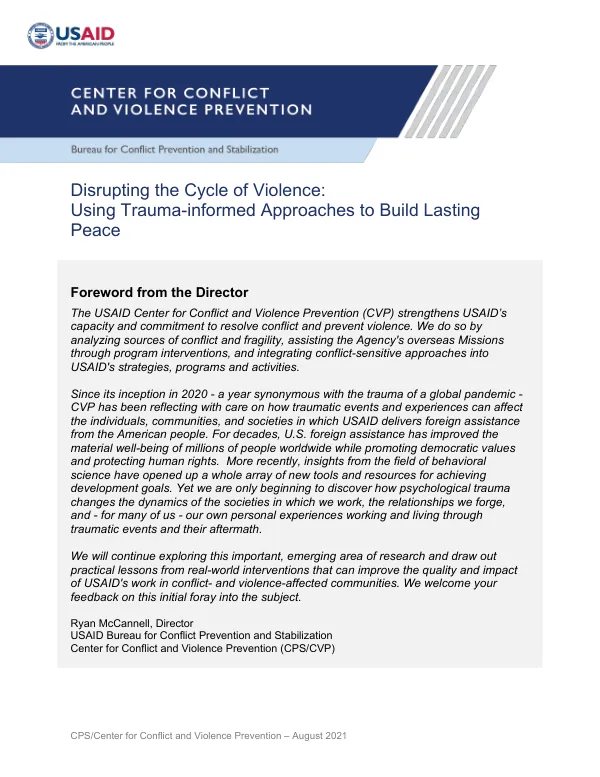
Disrupting the Cycle of Violence: Using Trauma-informed Approaches to Build Lasting Peace
The Center for Conflict and Violence Prevention (CVP) at the USAID Bureau for Conflict Prevention and Stabilization has been reflecting on the impact of traumatic events on individuals, communities, and societies.
2021 · 15 pages
Sign in to readA free account is required to download.
Abstract
The CVP has been analyzing sources of conflict and fragility, assisting USAID's overseas Missions through program interventions, and integrating conflict-sensitive approaches into USAID's strategies, programs, and activities. Globally, conflict and violence are on the rise, taking many different forms. Psychological trauma, the response to distressing events or stressors such as experiencing or witnessing violence, sexual assault, or living through a natural disaster, is often a consequence of exposure to violence and conflict. Trauma can have long-lasting impacts on many different aspects of a person's life, including increasing the likelihood of experiencing and perpetrating new violence, creating a vicious cycle. Addressing mental health issues that result from potentially traumatic events can be a powerful entry point for disrupting this cycle. The paper makes the case for using trauma-informed mental health and psychosocial support (MHPSS) approaches in conflict prevention and response programming. It outlines the psychological mechanisms that are thought to link trauma to violence perpetration and explores different trauma-informed interventions that can contribute to disrupting these pathways. Trauma can contribute to more violence through three main pathways: social learning and normalization of violence, mental health issues, and leaving survivors with limited alternatives. Integrating MHPSS interventions can be a powerful strategy for preventing future violence and conflict. Approaches that aim to combine MHPSS and peacebuilding are generally grounded in a socio-ecological model, locating the individual in their social, political, economic, historical, spiritual, and cultural context. Several focused and specialized psychosocial interventions have been tested in conflict-affected settings, including Cognitive Behavioral Therapy with a trauma focus, Interpersonal Psychotherapy, yoga and mindfulness interventions, and the Common Elements Treatment Approach. Cross-sectoral collaborations can provide strategic entry points for delivery of MHPSS interventions, such as healthcare systems, teachers, and school counselors. The field of trauma-informed programming in conflict and violence prevention and MHPSS in international development is rapidly growing. More research is needed to better understand how to utilize the potential of these approaches. Future research should further explore the pathway between traumatic experiences, MHPSS interventions, and likelihood of violence perpetration and perpetuation of conflict, and should specifically look at local mental health concepts, expression, and resources in the countries where USAID implements programs. The CVP aims to develop more detailed, field-focused, programming guidance and advocate for additional investment in this area. The paper highlights the importance of addressing the intersection between trauma, mental health, and gender in conflict-affected settings. By understanding the complex relationships between trauma, violence, and mental health, USAID can develop more effective programming to prevent conflict and promote peace.