USAID
Case Study—African Apparel Sector: Stitching Africa into the Global Value Chain
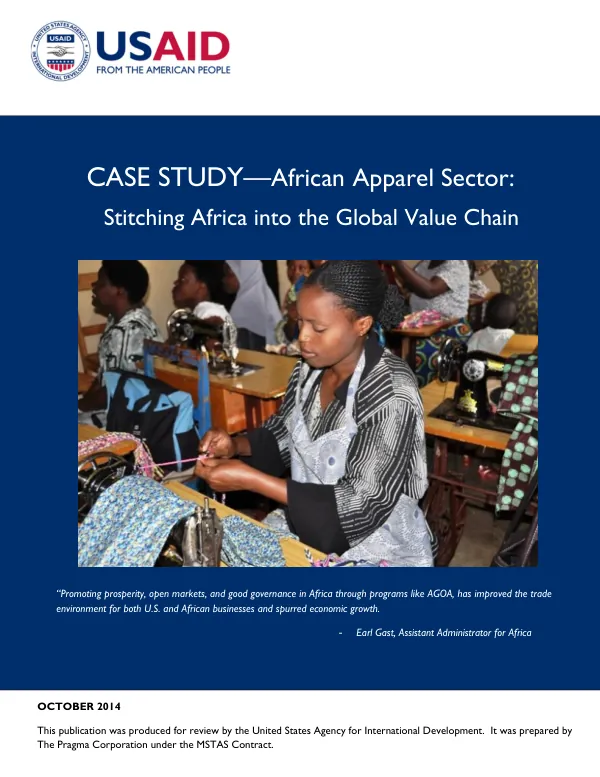
The African apparel sector has undergone significant transformation since the passage of the African Growth and Opportunity Act (AGOA) in 2000.
2014 · 11 pages
Sign in to readA free account is required to download.
Abstract
Prior to 2000, the industry in sub-Saharan Africa (SSA) was largely underdeveloped and concentrated within certain large economies, including South Africa, Nigeria, and Mauritius. These countries met local needs and supplied basic apparel articles to the European Union (EU). However, import substitution-led policies in most SSA countries could not sustain the industry against fierce international competition until the continent was provided with unprecedented market access through AGOA. AGOA extended duty-free benefits under the Generalized System of Preferences (GSP) program to include certain textiles and apparel articles. Average duty rates on U.S. imports of textiles and apparel are relatively high, reaching 32 percent for certain products. Preferential access to the U.S. market under AGOA attracted many Asian investors, primarily from China and Taiwan, to establish apparel production bases in SSA. To foster industrial development, African governments provided a variety of investment incentives, including tax exemptions and the creation of export processing zones (EPZs) as hubs for manufacturing activity. The U.S. government also played a key role in expanding the SSA apparel sector under AGOA. In 2002, USAID designed and funded the Trade for African Development and Enterprise (TRADE) project, which established the three African Trade Hubs in the East, West, and Southern regions of the continent. One of their primary objectives was to engage African government agencies, civil society, and businesses to increase exports to the United States. While Trade Hub support for AGOA is multi-sectoral, the apparel sector has received the most attention and resources over the past decade. Despite the growth of the SSA apparel sector, the industry continues to face significant challenges in establishing a sustainable and competitive global presence. Weak market linkages and information, inadequate trade logistics, and insufficient capital are among the most critical factors inhibiting SSA competitiveness in the apparel industry. Export-ready firms often struggle to identify and make contact with potential buyers and lack a coherent marketing strategy. SSA producers tend to be unfamiliar with product specifications, making it difficult for them to adapt production to meet the rapidly changing demands of international buyers and retailers. Intra-regional trade rigidities also pose a significant challenge to the SSA apparel industry. The industry operates on thin margins, and product replenishment schedules require rapid service. Efficient trade facilitation is of particular importance in supporting participation in the value chain. Major non-tariff barriers, including customs delays and rules of origin restrictions, prevail throughout the region, adding both time and costs to production schedules. SSA producers face major obstacles in accessing technology that could improve productivity and product quality. With scarce and relatively expensive capital, local producers are unable to obtain bank financing to invest in equipment to modernize their business or build new competencies to move up the supply chain. The East Africa Trade Hub (EATH) has driven enhanced competitiveness in the apparel sector by providing firm-level assistance, which supports direct business linkages between U.S. and East African firms. The EATH has also provided training and capacity-building programs to improve the skills and knowledge of SSA producers. The Trade Hubs have also played a crucial role in promoting the SSA apparel sector by providing market information and facilitating trade missions to the United States. These efforts have helped to increase investment, employment, and exports in the SSA apparel sector.