USAID DEC
Case study: Increasing institutional deliveries through improving community-facility linkages in Mewat, Haryana State, India
Sign inENCOMPASS, LLC
Case study: Increasing institutional deliveries through improving community-facility linkages in Mewat, Haryana State, India
The USAID ASSIST Project supported a community quality improvement (QI) team in Mewat, Haryana, to increase institutional deliveries among pregnant women.
2015 · 2 pages
Sign in to readA free account is required to download.
Abstract
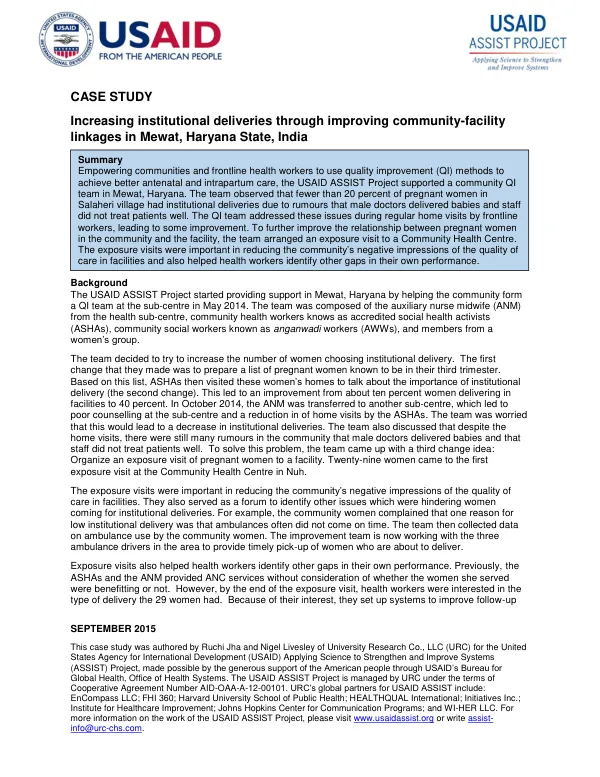
The team, composed of auxiliary nurse midwives (ANMs), accredited social health activists (ASHAs), community social workers (anganwadi workers), and women's group members, aimed to address the low institutional delivery rate in Salaheri village, which was less than 20 percent. The team identified rumors that male doctors delivered babies and staff did not treat patients well as primary barriers to institutional delivery. To address these issues, the QI team conducted regular home visits by frontline workers, which led to some improvement in institutional delivery rates. However, the team recognized the need for further action to improve the relationship between pregnant women in the community and the facility. To achieve this, the team arranged an exposure visit to a Community Health Centre (CHC) for pregnant women, which was a crucial step in reducing the community's negative impressions of the quality of care in facilities. The exposure visits not only helped to alleviate community concerns but also enabled health workers to identify gaps in their own performance. Previously, ASHAs and ANMs provided antenatal care (ANC) services without considering whether the women they served were benefiting or not. However, after the exposure visits, health workers became interested in the type of delivery the women had and set up systems to improve follow-up and tracking of women receiving ANC. The exposure visit idea was scaled up in Mewat and the neighboring district, Palwal, based on the initial success. The project's efforts led to a significant increase in institutional delivery rates, with 40 percent of women delivering in facilities after the exposure visits. The community's negative impressions of the quality of care in facilities were reduced, and health workers became more proactive in providing ANC services and reminding pregnant women of their next visit. One of the success stories of the project was Akbari's, a 35-year-old woman who was pregnant with twins and had five previous pregnancies. Akbari was initially skeptical about delivering in a hospital due to rumors about male doctors and their behavior towards pregnant women. However, after participating in a group meeting organized by an ANM and ASHA, Akbari was invited to visit the Community Health Centre (CHC) at Nuh to see the labor room and services provided to pregnant women. This exposure visit gave Akbari a great sense of relief, and she eventually delivered her twins at the CHC. Akbari's experience highlights the impact of the exposure visits on changing community perceptions and improving institutional delivery rates. The project's efforts demonstrate the effectiveness of community-based QI initiatives in improving maternal and child health outcomes in rural areas.