USAID DEC
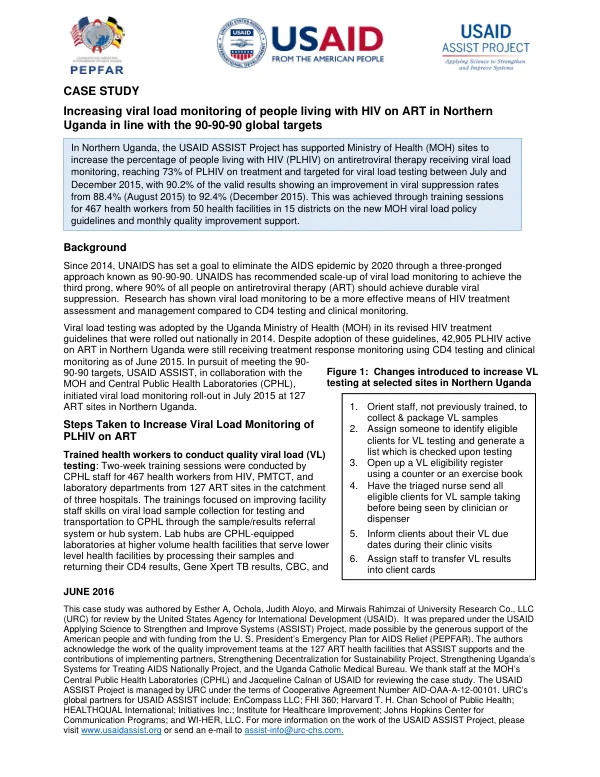
Increasing viral load monitoring of people living with HIV on ART in Northern Uganda in line with 90-90-90 global targets
Sign inENCOMPASS, LLC
Increasing viral load monitoring of people living with HIV on ART in Northern Uganda in line with 90-90-90 global targets
The USAID ASSIST Project in Northern Uganda aimed to increase viral load monitoring of people living with HIV on antiretroviral therapy (ART) in line with the 90-90-90 global targets.
2016 · 2 pages
Sign in to readA free account is required to download.
Abstract
The project was initiated in July 2015 at 127 ART sites in Northern Uganda, in collaboration with the Uganda Ministry of Health (MOH) and Central Public Health Laboratories (CPHL). The project focused on training health workers to conduct quality viral load testing, applying quality improvement methods to scale up viral load testing, and strengthening laboratory support for viral load testing. Two-week training sessions were conducted for 467 health workers from HIV, PMTCT, and laboratory departments from 127 ART sites in the catchment of three hospitals. The trainings focused on improving facility staff skills on viral load sample collection for testing and transportation to CPHL through the sample/results referral system or hub system. Quality improvement methods were applied to scale up viral load testing, with on-site coaching for 50 high-volume ART sites conducted within a month of training, and 77 low-volume sites reached two months later. Coaching aimed to assess progress of viral load testing in each site and encouraged sites experiencing slow roll-out to start working on their improvement aims. Changes introduced by sites to increase viral load testing are listed in Figure 1. Strengthening laboratory support for viral load testing involved targeted coaching at 11 hubs on a monthly basis to ensure that progress toward timely sample collection and results delivery is sustained. Through the assistance of district technical officers, ASSIST tracked the use of viral load test kits and dispatch forms to incentivize timely monthly ordering. ASSIST also distributed the supplied collection materials to the ART sites to avoid stock-outs that would otherwise interrupt testing. As a result of specific quality improvement efforts, the percentage of ART clients receiving viral load testing improved from 0% in July 2015 to 37% in October 2015 at 30 of the 50 high-volume sites. This improvement was maintained such that 15,923 of a targeted 21,653 PLHIV on treatment at 127 ASSIST-supported ART sites and 13 other non-supported sites in the region received a viral load test. Of those who got a viral load test recording, 92.4% maintained viral load suppression. Despite some setbacks due to interruptions in transportation of samples through the hub system, QI teams are dedicated to the continued implementation of their tested changes in order to achieve 100% access to viral load testing. District coaches identified from the 50 intense support sites are now spreading improvement efforts to 82 low-volume sites. The health facilities in Northern Uganda have been able to implement and scale up viral load testing among PLHIV through applying a quality improvement approach with a focus on improving accessibility to the viral load test and using the results for clinical decision-making. This performance has shown that achieving and sustaining the third prong of the 90-90-90 strategy in limited-resource settings is very possible.