GOVERNMENT OF THE REPUBLIC OF ZAMBIA
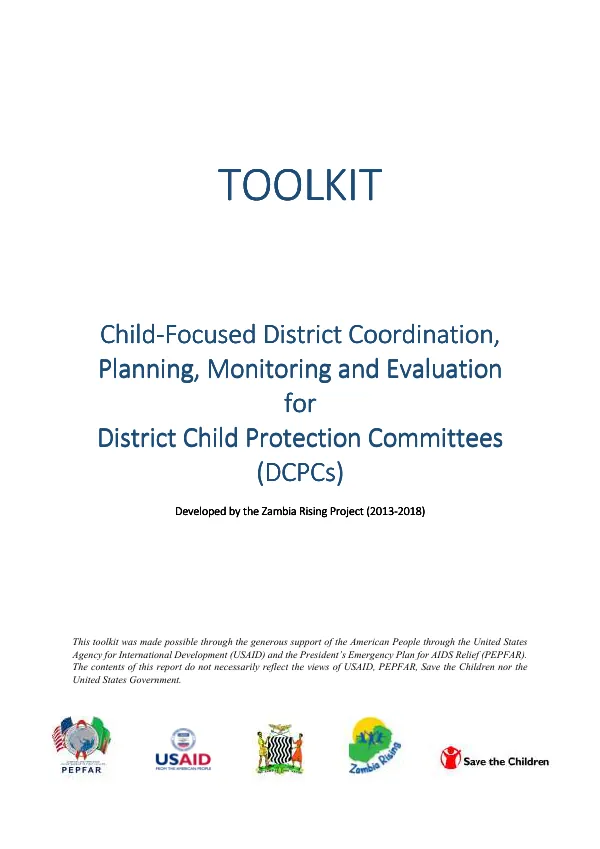
Child-Focused District Coordination Toolkit for Zambia
The Zambia Rising Project, implemented by Save the Children, aimed to improve systems and structures to ensure that the most vulnerable children have access to health and social services and family-based care.
2019 · 90 pages
Sign in to readA free account is required to download.
Abstract
The project was funded by the United States Agency for International Development (USAID) through the President's Emergency Plan for AIDS Relief (PEPFAR) and the USAID Displaced Children and Orphans' Fund (DCOF) from 2013 to 2018. The project was implemented in 16 districts across five provinces in Zambia, including Lusaka, Copperbelt, Central, Southern, and Luapula. The project focused on building the capacity of the Government of the Republic of Zambia (GRZ) to address the vulnerabilities faced by children and adolescents, including those affected by HIV/AIDS. The project supported the development of a decentralized, multi-sector coordinated approach across government, civil society, and private sector actors. One of the main strategies was to strengthen the coordination of stakeholders at district level between health and social services programs by revitalizing the existing GRZ coordination structure: the District Child Protection Committee (DCPC). The DCPC is a key structure for coordinating services for vulnerable children and adolescents, including those affected by HIV/AIDS. The committee brings together representatives from government ministries, civil society organizations, and the private sector to plan, implement, and monitor programs and interventions for children, adolescents, and their households. The DCPC is responsible for joint planning, data generation for decision-making, and monitoring and evaluation (M&E) of programs and interventions. The Zambia Rising Project developed a child-focused district coordination toolkit to guide joint planning and monitoring of all district care and support interventions for children. The toolkit includes templates for joint planning, M&E, and data dashboard development. The toolkit was developed in consultation with stakeholders, including government ministries, civil society organizations, and the private sector, and is based on the 2015 National Child Policy and its National Plan of Action for Children. The toolkit is designed to support the DCPCs in their coordination efforts and to ensure that programs and interventions are evidence-based and effective in addressing the needs of vulnerable children and adolescents. The toolkit includes guidelines for joint planning, data generation, and M&E, as well as templates for data collection and reporting. The toolkit is intended to be a living document that will be updated and refined over time to reflect the evolving needs of vulnerable children and adolescents in Zambia. The development of the toolkit was a collaborative effort involving the Zambia Rising technical, provincial, and M&E teams, as well as stakeholders from government ministries, civil society organizations, and the private sector. The toolkit is a key output of the Zambia Rising Project and is intended to contribute to the coordinated response for children's care and support in Zambia.