USAID DEC
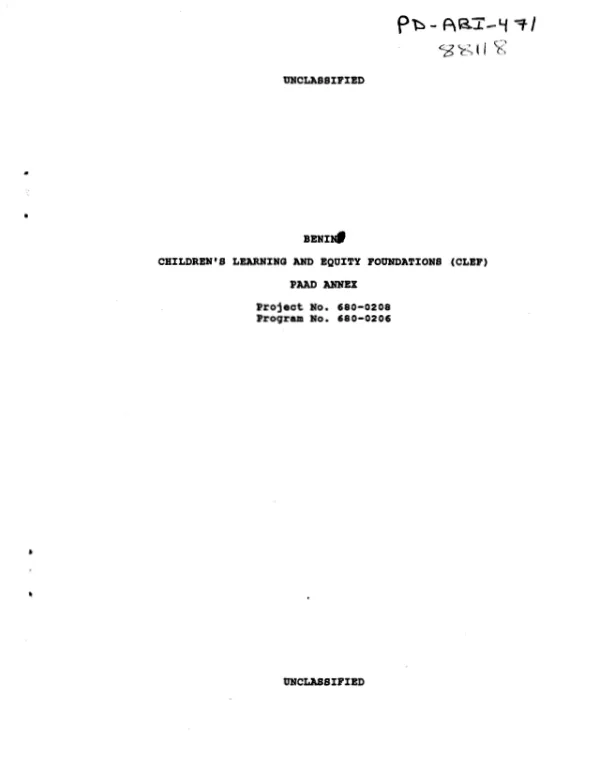
CHILDREN'S LEARNING AND EQUITY FOUNDATIONS (CLEF) PAAD ANNEX
The Children's Learning and Equity Foundations (CLEF) project in Benin aims to improve the quality of education and promote equity in the country's education system.
477 pages
Sign in to readA free account is required to download.
Abstract
The project is part of the overall education strategy for the Government of Benin (GOB) and is supported by the United Nations Development Programme (UNDP) and UNESCO. The project's overall program strategy focuses on improving the quality of primary education, increasing access to education for disadvantaged groups, and promoting equity in education. The strategy is based on the GOB's Education Policy Framework, which emphasizes the importance of improving the quality of education and promoting equity in education. The framework also highlights the need to increase access to education for disadvantaged groups, including girls, children from poor households, and children with disabilities. The project's socio-cultural analysis, conducted by Akpaka and Gaba, highlights the importance of understanding the cultural and social context of education in Benin. The analysis identifies the need to promote a culture of learning and to address the social and cultural barriers that prevent children from accessing education. The analysis also highlights the importance of involving local communities in the education process and promoting community-based initiatives to improve education. The project's teacher training study, conducted by Berreur and Agossou, emphasizes the need to improve the quality of teacher training and to promote a culture of continuous professional development among teachers. The study highlights the importance of providing teachers with the necessary skills and knowledge to teach effectively and to promote a culture of learning in the classroom. The study also emphasizes the need to address the shortage of qualified teachers in Benin and to promote a more equitable distribution of teachers across the country. The project's environmental examination, conducted by UNESCO-UNDP, highlights the need to address the environmental challenges facing education in Benin. The examination identifies the need to promote sustainable development and to address the environmental impacts of education, including the use of energy and water resources. The examination also highlights the importance of promoting environmental education and awareness among students and teachers. The project's overall program strategy is based on the Program Policy Matrix, which provides a framework for implementing the project's activities and achieving its objectives. The matrix highlights the need to promote a culture of learning, to improve the quality of education, and to promote equity in education. The matrix also emphasizes the need to involve local communities in the education process and to promote community-based initiatives to improve education. The project's procurement plan and methods of financing are outlined in the Procurement Plan and Methods of Financing document. The document highlights the need to ensure that the project's activities are implemented in a transparent and accountable manner and that the project's finances are managed in accordance with international standards. The project's educational statistics, published by the Ministry of Education, GOB, provide a comprehensive overview of the education sector in Benin. The statistics highlight the need to improve the quality of education and to promote equity in education. The statistics also emphasize the importance of increasing access to education for disadvantaged groups and promoting a culture of learning among students and teachers. The project's policy analysis, conducted by UNDP/UNESCO, highlights the need to promote a culture of learning and to address the policy challenges facing education in Benin. The analysis identifies the need to promote a more equitable distribution of resources and to address the social and cultural barriers that prevent children from accessing education. The analysis also emphasizes the importance of involving local communities in the education process and promoting community-based initiatives to improve education. The project's overall program strategy is based on the GOB's Education Policy Framework, which emphasizes the importance of improving the quality of education and promoting equity in education. The framework also highlights the need to increase access to education for disadvantaged groups and to promote a culture of learning among students and teachers.