TETRA TECH
Chimpanzee Surveys & Monitoring: Techniques and Best Practices
Chimpanzee surveys and monitoring involve the collection of data on chimpanzee populations, habitats, and interactions with humans.
4 pages
Sign in to readA free account is required to download.
Abstract
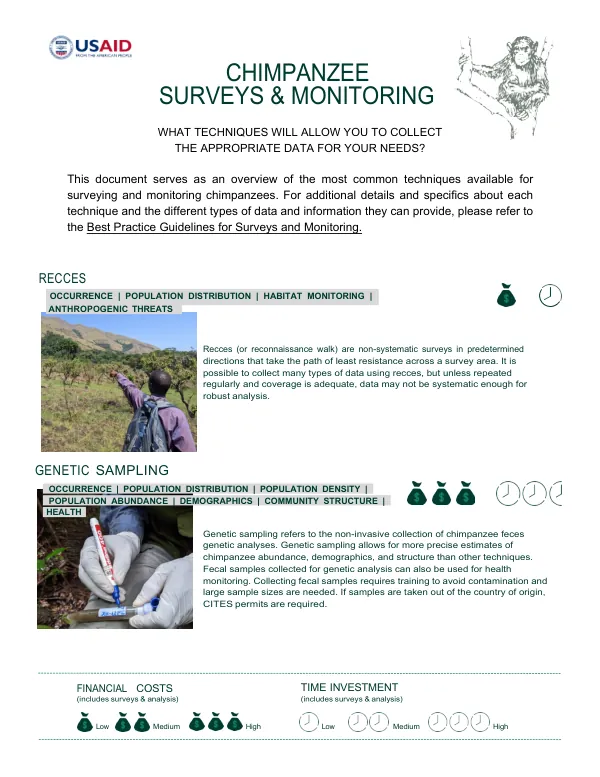
Various techniques are employed to gather this information, each with its own strengths and limitations. Recces, or reconnaissance walks, are non-systematic surveys that take the path of least resistance across a survey area. These surveys can collect data on occurrence, population distribution, habitat monitoring, and anthropogenic threats. However, unless repeated regularly and with adequate coverage, data may not be systematic enough for robust analysis. Genetic sampling involves the non-invasive collection of chimpanzee feces for genetic analysis. This technique allows for more precise estimates of chimpanzee abundance, demographics, and structure than other methods. Fecal samples can also be used for health monitoring, but collecting them requires training to avoid contamination and large sample sizes are needed. CITES permits are required if samples are taken out of the country of origin. Camera trapping involves the use of motion-triggered cameras placed randomly or systematically across a study area. These cameras can be used with distance sampling methods as well as spatially explicit capture-recapture modeling. Camera trapping allows for continuous data collection using automatic detection, although coverage is limited. It also provides direct insights into chimpanzee behavior. Line transects involve observers walking along straight lines of known length, which are either placed randomly or systematically across a survey area. Along linear transects, the observer records the number of objects of interest, the perpendicular distance between the object and the line, distance along the line, and additional ancillary data. This technique can collect data on occurrence, population distribution, population density, and anthropogenic threats. Passive acoustic monitoring uses autonomous recording units to remotely record noises, from chimpanzee vocalizations and drums to noisy human activities. This technique allows for continuous data collection using automatic detection, but technical expertise is required and methodological gaps between data acquisition and processing still exist. Interviews can be conducted in person or remotely using questionnaires, providing insights into human-chimpanzee dynamics. Social science expertise is required in designing and conducting interviews, which have the potential for biases and inaccuracies. Interviews can be structured or semi-structured, allowing for open-ended discussions. Environmental DNA (eDNA) involves the extraction of DNA from contaminated water or soil, which can be used to identify species. This technique can be used where chimpanzee density is low, but it does not provide precise spatial or temporal data on chimpanzee occurrence and is still a relatively new technique in development. Satellite remote sensing uses sensors on satellites to detect and record energy reflected or emitted from the earth's surface. These data are then processed into imagery and used for various applications, such as land cover analysis. This technique allows for continuous data collection over large extents with high temporal resolution, but it requires technical expertise and can be limited by cloud cover. Aerial surveys use unmanned aerial vehicles (UAVs), or drones, equipped with sensors to collect data about the earth's surface. Aerial surveys provide real-time remotely sensed data at high spatial resolution, but often only cover small extents. This survey technique requires technical expertise and training. The time investment and financial costs associated with these techniques vary, ranging from low to high. The choice of technique depends on the specific research question, available resources, and the level of detail required.