USAID DEC
Civil Society and Media Leadership (CSML) Program Final Report: Trusted Voices in Challenging Times
Sign inIREX
Civil Society and Media Leadership (CSML) Program Final Report: Trusted Voices in Challenging Times
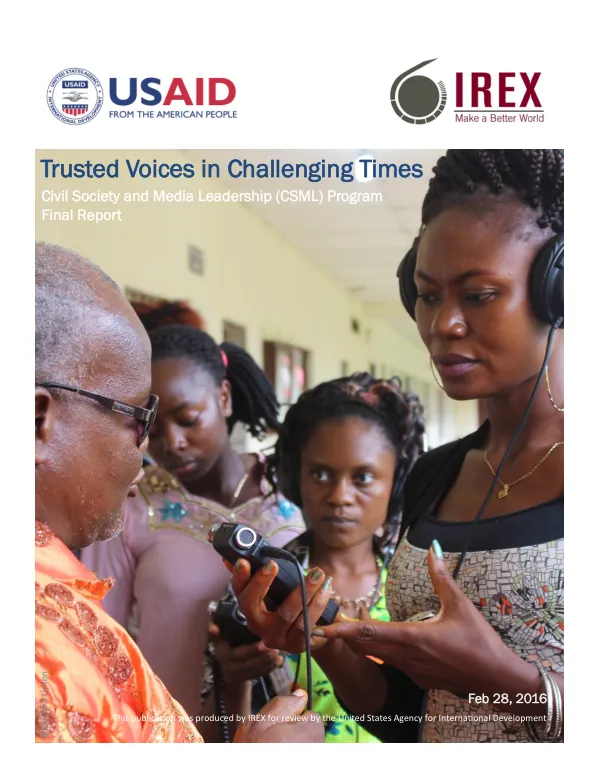
The Civil Society and Media Leadership (CSML) Program aimed to sustain peace in Liberia through greater inclusion, giving a voice to, informing and engaging Liberian citizens.
2016 · 150 pages
Sign in to readA free account is required to download.
Abstract
IREX partnered with The Carter Center, Social Impact, and over 100 Liberian institutions to build the capacity of the media and civil society sectors. The program provided intensive support, including training, mentoring, small grants, and equipment to over 60 civil society organizations and 35 media outlets in 15 counties. For over five and one-half years, the CSML team contributed to building a more capable, collaborative, and agile civil society and media sector in Liberia. The team distributed over $6 million in grants to civil society organizations to conduct advocacy, reconciliation, civic and voter education, Ebola awareness raising, and contribute to their own organizational development. Community radio stations received a total of over $400K worth of equipment, including 19 transmitters. The Carter Center trained 3,500 chiefs, women, and youth to advance access to justice and resolve community disputes, and broadened awareness of Freedom of Information to over 15,000 Liberians across the seven original target counties. As a result of the CSML program, IREX's civil society partners conduct advocacy that is more informed and less confrontational, engage the media as a key stakeholder, and have more productive strategies for engaging local and national government. IREX's community radio partners have better trained staff, capable of developing conflict-sensitive, ethical content that reflects and responds to local priorities. Many of these partners have wider listening coverage, with partner stations in the original target counties increasing reach from 79% to 91% of their target populations. Community radio stations have improved relationships with their listeners, resulting in more targeted and relevant content and increased community investment, both literal and figurative, in the survival of the station. CSML's Monrovia-based media partners employ journalists that have enhanced confidence and capacity to report on priority issues and produce investigative stories that challenge the status quo and broaden the conversation beyond politics. Media managers better understand the media market and advertising opportunities and are accessing new partnerships and funds as a result. Media associations, including the Association of Liberia Community Radio (ALICOR) and the Press Union of Liberia (PUL), have stronger management foundations, policies, and procedures, and are collaborating on more initiatives towards the sustainable betterment of the sector. Female journalists have increased in number and capacity, producing content for newspapers, radio, and TV that heightens the voices of all Liberians, including its most marginalized and historically silent citizens. Many Station Managers are more aware of their responsibility to support all of their staff, regardless of gender, and provide opportunities for aspiring female journalists to learn and grow professionally. Media outlets across the country benefit from a ratified Gender Policy, developed by the Liberia Women Media Action Committee (LIWOMAC) in partnership with the Female Journalists Association of Liberia (FeJAL) and the PUL, which establishes standards for women's engagement and inclusion in the media sector. Civil society and media institutions collaborate to achieve shared goals, and have seen clearly their importance in times of elections and international crises. Community radio stations better recognize their responsibility to share accurate information when distrust of government and international voices is rampant, and community leaders identified a new platform for sharing concerns and mobilizing one another towards positive behavior change in the face of tremendous fears. The CSML team has learned valuable lessons, including the need for additional and earlier support to effectively serve as mentors for their assigned institutions, and the importance of increased monitoring to maintain quality and impact for their mentees. Simplification is encouraged when designing a program, as fewer activities may yield higher results, and additional investment in basic resources for partners, such as computers and desks, may be necessary to provide the necessary foundation for growth.