SOCIAL IMPACT, INC.
After Action Review: Liberia's 2017 Electoral Process
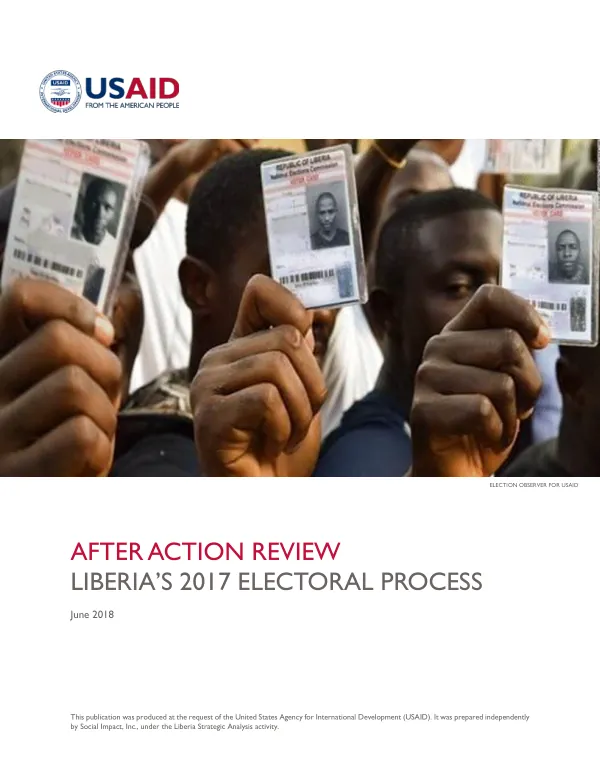
The 2017 electoral process in Liberia was a historic democratic transition of power from President Ellen Johnson Sirleaf to Senator George Manneh Weah.
2018 · 51 pages
Sign in to readA free account is required to download.
Abstract
The National Elections Commission (NEC) was fully in charge of managing the process, with international donors and partners playing a secondary role through technical and financial assistance. USAID started planning for the 2017 elections more than four years in advance, with an initial suite of activities that included technical and administrative support to the NEC, election observation, and civic and voter education (CVE) in all 15 counties. Technical and administrative support to the NEC included providing training and capacity-building programs for NEC staff, as well as assistance with voter registration and election logistics. Election observation was conducted by USAID, with support to Liberia's largest domestic election observation network, the Liberia Election Observation Network (LEON). CVE activities were implemented in all 15 counties to promote informed citizen participation in the electoral process, with a particular focus on women, first-time voters, persons with disabilities, and other hard-to-reach voters. In 2015 and 2016, USAID conducted assessments on electoral access and participation, conflict vulnerability, electoral security, and political parties. These assessments informed the adjustment and expansion of programming as the electoral process unfolded. Drawing on the findings of these assessments, USAID/Liberia added activities to strengthen women's participation and leadership in the electoral process, including training and capacity-building programs for women candidates and party officials. The success of the 2017 electoral process was attributed to the collaborative efforts of the NEC, international donors, and local stakeholders. The NEC was commended for its professionalism and independence in managing the electoral process. The Liberian people were also praised for their peaceful and orderly conduct during the elections. The 2017 electoral process marked a significant milestone in Liberia's democratic transition, and USAID's support played a crucial role in ensuring the success of the process. The after-action review (AAR) team spent one month in Liberia interviewing elections stakeholders, including NEC officials, political party representatives, and civil society organizations. The AAR team assessed the extent to which USAID's elections and political processes portfolio holistically contributed to Liberia's 2017 electoral process. The review showed that USAID's support helped voters and political parties trust the NEC to manage the process fairly and gave them many opportunities to engage with each other, contributing to a peaceful and credible electoral process. The AAR team identified several key factors that contributed to the success of the 2017 electoral process, including the NEC's professionalism and independence, the collaborative efforts of international donors and local stakeholders, and the peaceful and orderly conduct of the Liberian people. The review also highlighted the importance of civic and voter education in promoting informed citizen participation in the electoral process. The AAR team recommended that USAID continue to support the NEC and other local stakeholders in their efforts to strengthen Liberia's democratic institutions and promote peaceful and credible electoral processes.