ABT ASSOCIATES
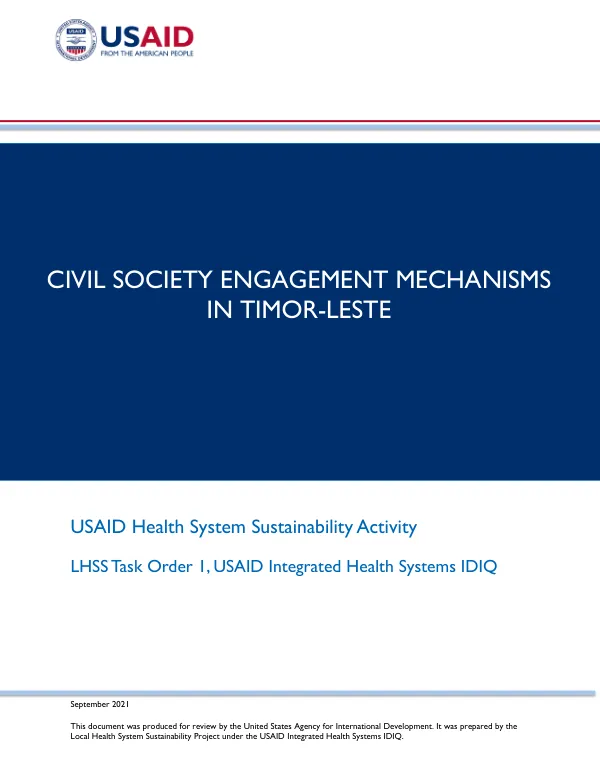
Civil Society Engagement Mechanisms in Timor-Leste
Civil society organizations (CSOs) have played a crucial role in Timor-Leste's history, serving as a primary source of mobilization and resistance to Indonesian rule before the country's independence.
2021 · 18 pages
Sign in to readA free account is required to download.
Abstract
Today, CSOs in Timor-Leste include local, national, and international organizations that deliver social services, conduct research, advocate on key public policy issues, and foster social life in the country. The Forum Organizasaun Naun Govermentál Timor-Leste (FONGTIL; Timor-Leste NGO Forum) is an umbrella NGO that has 201 registered local CSOs, with 34 engaged in health-related programming. Timor-Leste's parliamentary system, in which people vote for a party and the party fills the seats, means there is no clear constituent representation. People vote for a political party, but then the party appoints its political member to represent citizens in the Parliament. Timorese citizens are generally aware of Parliament roles, but don't know to whom they should address relevant community issues. Many citizens do not fully understand their role in participatory governance beyond elections. Similarly, concepts of community mobilization in Timor-Leste are still not effectively operationalized. CSOs are often unaware of the services and goods the Government of Timor-Leste (GoTL) should be providing to Timorese, or they see a gap but do not feel empowered to communicate shortcomings. There is no clear mechanism for CSOs to advocate for change, and they often encounter challenges accessing and interpreting data, hindering their ability to use evidence-based advocacy. Within the health sector, an evaluation of the USAID Reinforce activity reported that no community members or subnational officials felt prepared to advocate at the national or subnational level for the allocation of resources and human resource deployment required to sustain service delivery. A capacity assessment report by the FONGTIL indicated that its members have limited capacity to develop strategic plans and design programs, which has further affected their ability to apply for funding support. In 2021, out of 200 CSOs that applied for grants from the government, only nine secured funding. According to the GoTL's Gabinete Apoiu Sosiedade Civil (GASC; Civil Society Support Unit), the majority of proposals were not shortlisted because the way projects were designed or described did not meet the government grant requirements. However, there have been promising advances in the past few years. In 2015, the GoTL launched the Social Audit Program, wherein the government partnered with CSOs at the national and Suco (village) levels to monitor and provide information about the status of health facilities in the country. The audit results are used to hold a dialogue with stakeholders including the Ministry of Health (MoH), district health offices, and civil society on how to address identified problems. In addition to the Social Audit Program, CSOs can raise their perspectives to government counterparts through mechanisms such as the Annual National Retreat between CSOs and government, the FONGTIL's sectoral dialogue between CSOs and line ministries, the Social Audit Mechanism, the Municipal Consultative Meeting and Conselho do Suco (Village Council), and the MoH's thematic working group. As part of its work to improve civic engagement, the USAID Health Systems Sustainability Activity in Timor-Leste conducted a review of CSOs and voluntary community health workers (CHWs) in Timor-Leste, and their capacity, their engagement with government stakeholders, and mechanisms that aim to raise their awareness of the citizens' health rights and rights to advocate for the fulfillment of these rights. This report offers recommendations to strengthen engagement mechanisms and increase CSOs' and community awareness of health services and citizens' rights. The review aimed to identify the capacity of CSOs and CHWs in Timor-Leste, their engagement with government stakeholders, and mechanisms that aim to raise their awareness of the citizens' health rights and rights to advocate for the fulfillment of these rights. The report also aimed to provide recommendations to strengthen engagement mechanisms and increase CSOs' and community awareness of health services and citizens' rights. The review found that CSOs and CHWs in Timor-Leste face several challenges, including limited capacity to develop strategic plans and design programs, lack of clear mechanisms for engagement and advocacy, and limited access to data and information. However, the review also identified several promising advances, including the Social Audit Program and other mechanisms for CSOs to raise their perspectives to government counterparts. Based on the review, the report provides recommendations to strengthen engagement mechanisms and increase CSOs' and community awareness of health services and citizens' rights. The recommendations include developing a clear and comprehensive framework for CSO engagement, providing training and capacity-building programs for CSOs and CHWs, and establishing a system for CSOs to access and interpret data and information. The report also recommends increasing the participation of CSOs in decision-making processes and providing support for CSOs to develop strategic plans and design programs. The report concludes that strengthening engagement mechanisms and increasing CSOs' and community awareness of health services and citizens' rights is critical