ABT ASSOCIATES
Experiences in Implementing Health Worker Productivity Reforms in Timor-Leste
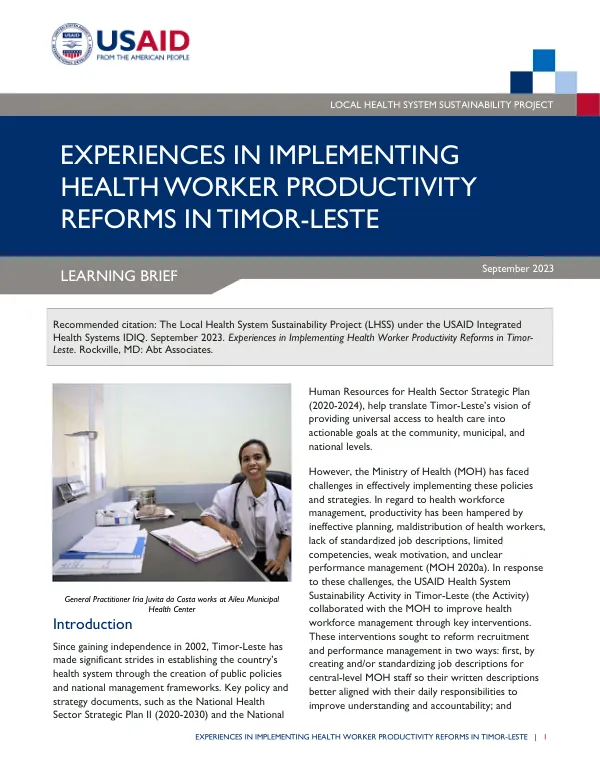
The Local Health System Sustainability Project in Timor-Leste implemented health worker productivity reforms in 2022, with the goal of improving health workforce management.
2023 · 9 pages
Sign in to readA free account is required to download.
Abstract
The Ministry of Health (MOH) faced challenges in effectively implementing policies and strategies, including ineffective planning, maldistribution of health workers, and unclear performance management. In response, the USAID Health System Sustainability Activity collaborated with the MOH to improve health workforce management through key interventions. The interventions focused on creating and/or standardizing job descriptions for central-level MOH staff and establishing a performance evaluation framework for frontline health workers at the primary level. The job description development manual and performance evaluation manual were developed with technical and financial support from the USAID Activity. The ultimate goals of these reforms were to set clear expectations for what health worker cadres are supposed to do, improve productivity and motivation through recognition of high-performing health workers, and support improved competencies where needed. The development process involved a desk review of documents, interviews, and a series of workshops, technical discussions, and consultations involving all stakeholders from the health sector. The NDHR team consulted with a wide range of stakeholders, including national directors, general directors, and municipality health directors from the MOH, health cadres from the primary, secondary, and tertiary levels, and health professional associations. Drawing on the expertise of these diverse stakeholders ensured that the manuals would be well informed and allowed the development team to address any stakeholder concerns. The job description and performance evaluation manuals were intended to be used by frontline health workers, and the NDHR engaged with relevant health workers at health posts, community health centers, and the Guido Valadares National Hospital. This engagement took place through meetings, interviews, workshops, and technical discussions, and was aimed at drawing on the health workers' firsthand knowledge of health professionals' roles, tasks, challenges, and the skills required to excel in their positions. The USAID Activity's collaborative approach to developing the manuals emphasized that maintaining accurate job descriptions and effective performance requirements is an ongoing responsibility and function of the NDHR. Co-funding the manuals' development helped the MOH understand the level of expenditure required to implement and further refine the manuals. By involving champions nominated by the MOH, the process encouraged ongoing use of the manuals within the MOH. The development of the job description and performance evaluation manuals was a collaborative effort involving the MOH, the USAID Activity, and a wide range of stakeholders. The manuals were developed with the goal of improving health workforce management and productivity in Timor-Leste. The ultimate goals of these reforms were to set clear expectations for what health worker cadres are supposed to do, improve productivity and motivation through recognition of high-performing health workers, and support improved competencies where needed. The MOH ownership of the manuals was further enhanced by having the ministry contribute funding to the co-development process. The USAID Activity's collaborative approach to developing the manuals emphasized that maintaining accurate job descriptions and effective performance requirements is an ongoing responsibility and function of the NDHR. The development of the job description and performance evaluation manuals was a critical step in improving health workforce management and productivity in Timor-Leste. The MOH has faced challenges in effectively implementing policies and strategies, including ineffective planning, maldistribution of health workers, and unclear performance management. In response, the USAID Health System Sustainability Activity collaborated with the MOH to improve health workforce management through key interventions. The interventions focused on creating and/or standardizing job descriptions for central-level MOH staff and establishing a performance evaluation framework for frontline health workers at the primary level.
Related documents