ABT ASSOCIATES
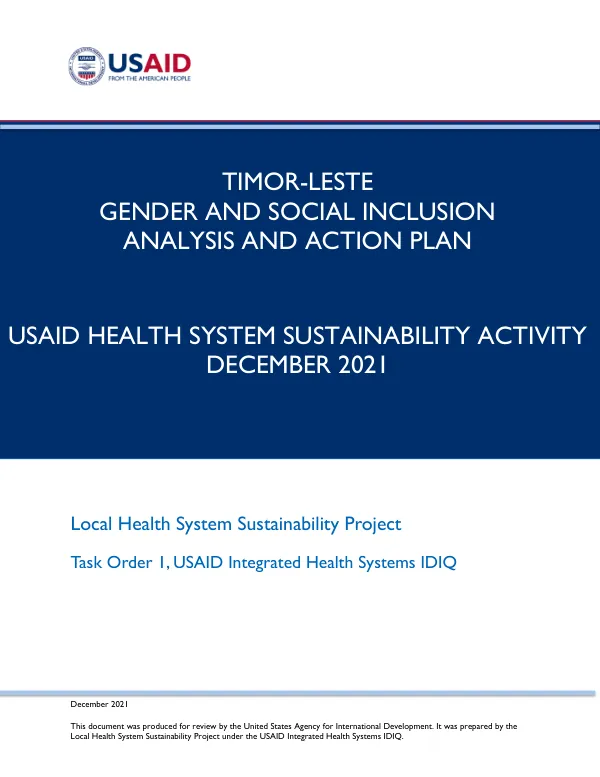
Timor-Leste Gender Equity and Social Inclusion Analysis and Action Plan
The Local Health System Sustainability Project in Timor-Leste aims to strengthen the country's health system through sustainable financing and governance.
2021 · 41 pages
Sign in to readA free account is required to download.
Abstract
The project is led by Abt Associates and is funded by the United States Agency for International Development (USAID) under the Integrated Health Systems IDIQ. The project's primary objective is to support Timor-Leste in transitioning to a self-financed health system, ensuring universal health coverage and improving the quality of health services. The project focuses on four key objectives: strengthening health sector governance and financing, strengthening health sector workforce management, improving healthy behaviors, and improving civic engagement and advocacy for health system strengthening. To achieve these objectives, the project works closely with local stakeholders, including government agencies, civil society organizations, and community groups. A key finding of the project's gender equity and social inclusion (GESI) analysis is that Timor-Leste lacks capacity to generate, interpret, and use quality data on gender and other social vulnerabilities. The Ministry of Health has made some improvements in data disaggregation, but the absence of reliable and regular disaggregated data remains a significant challenge for evidence-based policy making and planning. The analysis also highlights the importance of gender mainstreaming in the Ministry of Health, with strong female leadership but limited capacity, resources, and priority for gender mainstreaming. The Ministry has a gender focal point to promote gender equity policy and gender in planning, but implementation is still far from reaching established goals. In terms of workforce management, the health workforce in Timor-Leste is dominated by men, with a significant imbalance in the number of men and women in Ministry of Health establishment posts. However, there is a more balanced gender distribution among medical doctors, with the majority of nurses being male and midwives being almost exclusively female. The project's GESI analysis also highlights the importance of addressing gender-related factors that affect retention, including sexual harassment and lack of safe accommodation, particularly in remote or suco areas in municipalities. The incidence of gender-based violence (GBV) is also a significant concern, with several cases reported in the health sector. To address these challenges, the project has developed a GESI action plan, which includes tasks such as integrating GESI into work plan activities, providing training on key gender topics, and promoting gender-responsive budgeting. The project also aims to strengthen the capacity of the Ministry of Health to generate, interpret, and use quality data on gender and other social vulnerabilities. The project's stakeholder mapping exercise identified key stakeholders, including government agencies, civil society organizations, and community groups, who will be involved in the implementation of the GESI action plan. The project also aims to engage with local communities and civil society organizations to promote awareness and understanding of GESI issues and to build their capacity to advocate for GESI. Overall, the project's GESI analysis and action plan aim to address the significant challenges facing Timor-Leste's health system, including the lack of capacity to generate and use quality data, the imbalance in the health workforce, and the incidence of GBV. By strengthening the capacity of the Ministry of Health and local stakeholders, the project aims to promote a more inclusive and equitable health system that addresses the needs of all citizens, particularly women and marginalized groups.
Related documents