USAID. MISSION TO EL SALVADOR
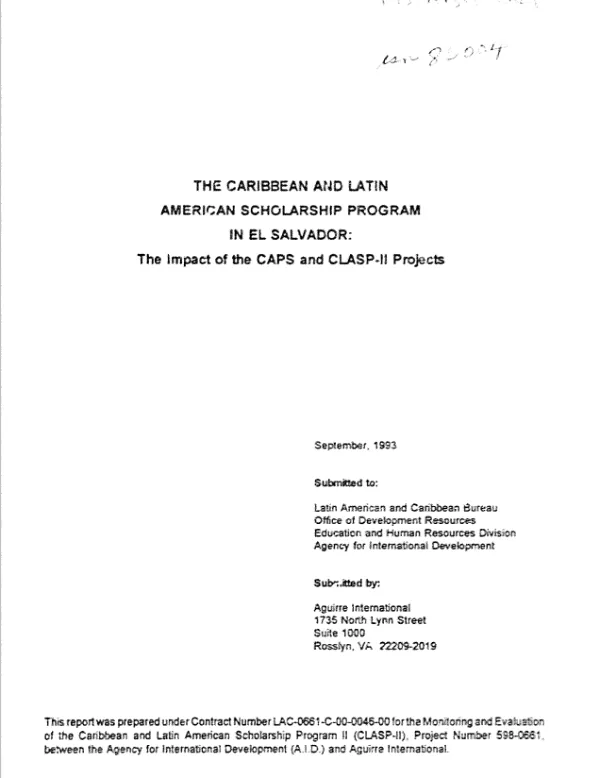
CLASP [Caribbean and Latin American scholarship program] special report
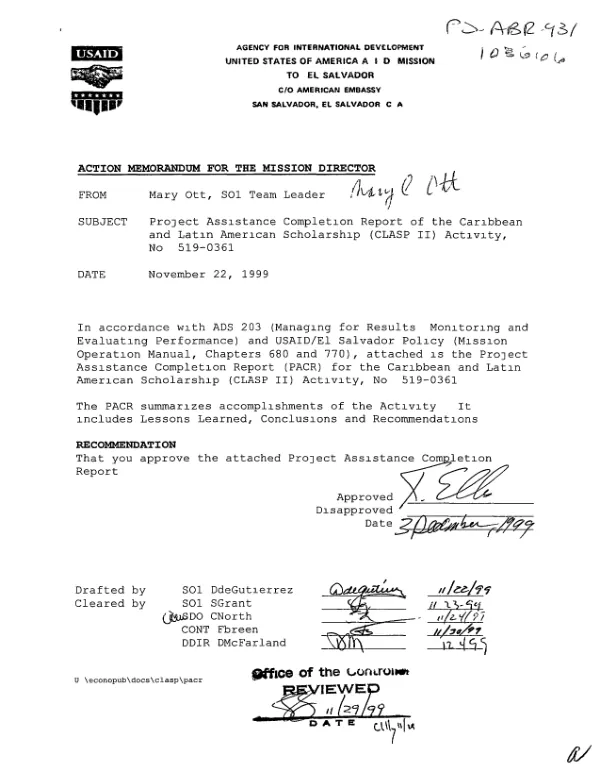
Special report by USAID/El Salvador on the impact of two participant training programs: the Caribbean and Latin American Scholarship Program II (CLASP II, which began in 1990), and its predecessor, the Central American Peace Scholarship (CAPS, 1985-92) Program.
1993
Sign in to readA free account is required to download.
![CLASP [Caribbean and Latin American scholarship program] special report](https://covers.devme.ai/gen/7317.webp)
Abstract
The purpose of the report is to present information (not included in a recent external evaluation, PD-ABH-061) on national-level impacts that support the Mission's strategic objectives. According to the report, the CLASP program is having an often unrecognized nationwide impact in several areas. For example, The CLASP Program for Leaders of Primary Education (CAPS Teachers Program) resulted in the establishment of a nationwide cadre of 226 teacher trainers, who have served as an invaluable resource and have assisted in developing a new teaching methodology for grades K-6. The program is now being used as a model for training in both Honduras and Nicaragua. The Teachers of English as a Foreign Language Program is establishing, for the first time in El Salvador, a curriculum and modern methodology for teaching English in the public school system nationwide. As a result of the program, the number of hours of English taught each week has increased from 2 to 3 in pilot areas, and certain classrooms have been designated as English language training centers. The Teachers' Program for Urban Schools with Social Problems has trained 33 teachers, directors, and supervisors from 6 urban schools in methods for coping with social problems; those trained have in turn trained more than 1,200 of their colleagues, representing 30 of the nation's most plagued urban schools. A second urban schools program is planned. The National University Project, scheduled to begin in January 1994, will provide U.S. training to 25 of the University's planners. A key result of this training will be a draft 5-year development plan for the University, in what is hoped will be a first step in the restructuring of the nation's higher education system. The Women's Leaders Program provided a nationwide network of field workers and managers with specialized women in development training, including an 8-week session for 80 field workers and their supervisors, and 2 weeks of U.S. training for 22 executives; training was aimed at establishing procedures for assuring that grassroots women in development (WID) concerns are addressed at the national level. Eight national-level action committees have been established and have been active and successful in promoting WID. The Mayors' Program has provided more than half the nation's mayors with their first in-depth training in the principles of managing a democratic system of government and with firsthand experience of how this is done in the United States. While it is difficult to attribute measurable policy-level changes to the program, there are indications that the experience has enhanced the mayors' concept of the value of the democratic system. A second program will be held after the mayoral elections in January 1994.
![CLASP [Caribbean and Latin American scholarship program] special report](https://covers.devme.ai/gen/42633.webp)