USAID
Clean Cooking to Protect Maternal and Child Health
Household air pollution is a leading risk factor for disease and death, particularly among women and children.
2017 · 8 pages
Sign in to readA free account is required to download.
Abstract
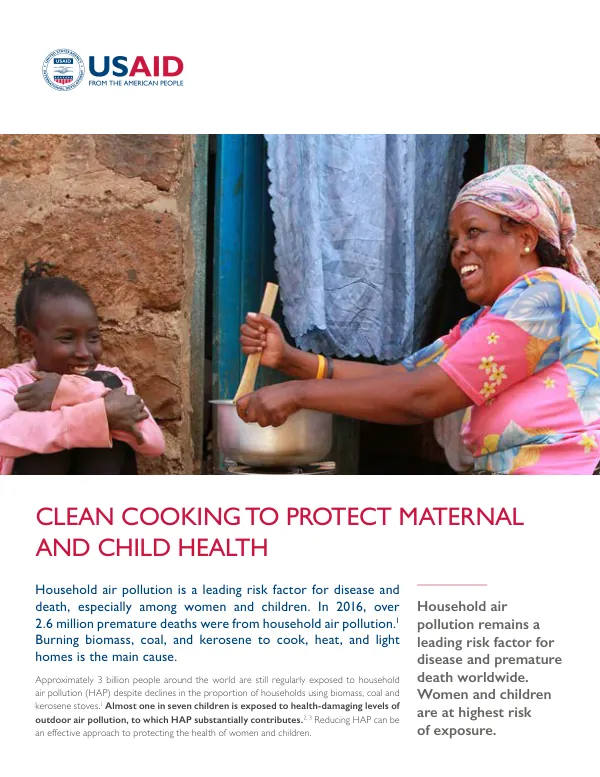
In 2016, over 2.6 million premature deaths were attributed to household air pollution, with biomass, coal, and kerosene burning being the primary causes. Approximately 3 billion people worldwide are regularly exposed to household air pollution, with almost one in seven children exposed to health-damaging levels of outdoor air pollution, which household air pollution substantially contributes to. Household air pollution remains a leading risk factor for disease and premature death worldwide, with women and children at highest risk of exposure. Children may be particularly susceptible to the health impacts of air pollution due to faster breathing rates and developing systems. Evidence of the maternal and child health outcomes associated with exposure to household air pollution comes from observational studies and a small number of randomized controlled trials, which evaluate health impacts among users of traditional biomass stoves and open fires compared with users of clean stoves and fuels such as liquefied petroleum gas (LPG). Household air pollution comprises levels of particulate matter (including fine particulate matter PM2.5) and gases that can exceed air pollution exposures in even the most polluted urban settings. PM2.5 can penetrate deep into the lungs and trigger systemic inflammation and oxidative stress, and is considered the best indicator air pollutant to estimate the negative health impacts of air pollution. Exposure-response relationships between PM2.5 and risk of pneumonia, lung cancer, COPD, and cardiovascular outcomes estimate that exposure to household air pollution is detrimental to the health of infants, children, and adults. To minimize the disease burden of household air pollution, the World Health Organization recommends achieving an interim indoor air quality target of 35 μg/m3 for annual mean PM2.5, although adverse health outcomes occur at concentrations well below this target. The World Health Organization also advises against the indoor use of coal and kerosene. Successful household air pollution interventions require consistent and exclusive use of clean fuels and improved stoves with confirmed efficiency and low emissions. Improving health may also require reducing air pollution from neighboring homes and other outdoor sources. System-wide policies are needed for large-scale changes in clean cooking and household energy use to decrease household air pollution. Effective policies incentivize clean cooking and fuel use through subsidies and campaigns, while discouraging the burning of polluting fuels via bans or removing subsidies for kerosene.