USAID DEC
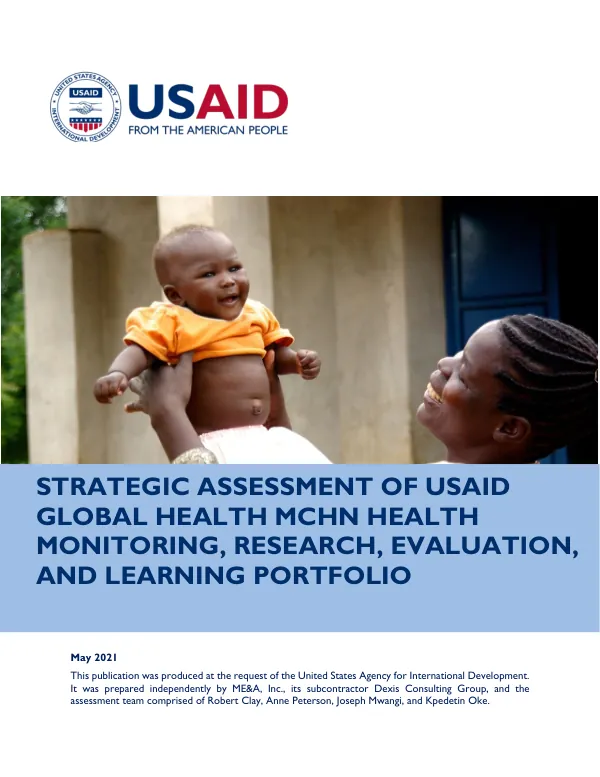
Strategic Assessment of USAID Global Health MCHN Health Monitoring, Research, Evaluation, and Learning Portfolio
Sign inECO CONSULTING GROUP
Strategic Assessment of USAID Global Health MCHN Health Monitoring, Research, Evaluation, and Learning Portfolio
The Research and Policy Division at USAID's Global Health Bureau is responsible for implementing the Maternal and Child Health and Nutrition (MCHN) Office's strategic priorities.
2021 · 132 pages
Sign in to readA free account is required to download.
Abstract
The division's portfolio includes Monitoring and Evaluation (M&E), implementation research (IR), knowledge management (KM), and knowledge translation (KT), collectively referred to as Learning and Adaptive Management (L&AM). A mixed-methods approach was employed to gather input from various stakeholders, including an online survey and 76 in-depth individual and group interviews. The assessment revealed that L&AM is highly valued, and technical assistance (TA) is desired. However, respondents identified more than 20 obstacles to the routine use of L&AM, with lack of time and priority relative to results being the most common obstacles. The components of L&AM are inter-related, and respondents deemed knowledge management and knowledge translation as needing the greatest attention. Implementation research was seen as the most distinctive strength of the RP Division. The assessment team identified qualities of good L&AM and TA, including the importance of community voice and interpersonal skills to engage the local voice. Respondents affirmed the RP Division's roles at global policy, cross-office, and mission levels, with specific recommendations at each level. Cross-cutting methodologic support in L&AM was also emphasized. Key recommendations from the assessment include clarifying and clearly communicating the RP Division's mission and value proposition, shifting the emphasis from "doing" to "service" of partner priorities, and ensuring that all technical staff have strong interpersonal skills, an understanding of L&AM, and are cross-trained in L&AM technical areas. The MCHN Office should also ensure that L&AM is embedded at the onset of project planning, design, and implementation, and the Bureau of Global Health should encourage an enabling environment that promotes cross-bureau collaboration and prioritizes L&AM application to implementation. The assessment team acknowledges the support and guidance provided by the RP Division, the Stakeholder Group, and other individuals who contributed to the assessment. The team also recognizes the importance of community voice and interpersonal skills in engaging the local voice and ensuring better health outcomes for the world's children. The Research and Policy Division's portfolio includes several technical focus areas, including data analysis and monitoring, evaluation, and learning (MEL), health research, including implementation research (IR) and knowledge management (KM)/knowledge translation (KT), and maternal and child health/community health. The division's priorities were informed by the 2014 Health Research Priorities (HRP) Evaluation. The assessment design employed a mixed-methods approach, combining desk review, key informant and group interviews, a headquarters survey, and data collection tools and approach. The sample selection involved a combination of purposive and snowball sampling, and data management and analysis were conducted using a variety of software and tools. Ethical considerations and human subject protection were also taken into account during the assessment. The findings of the assessment are presented in the following sections, addressing the assessment questions and providing an overview of the Research and Policy Division's background, assessment design, methods, and limitations.