BANK FOR WEST AFRICAN DEVELOPMENT
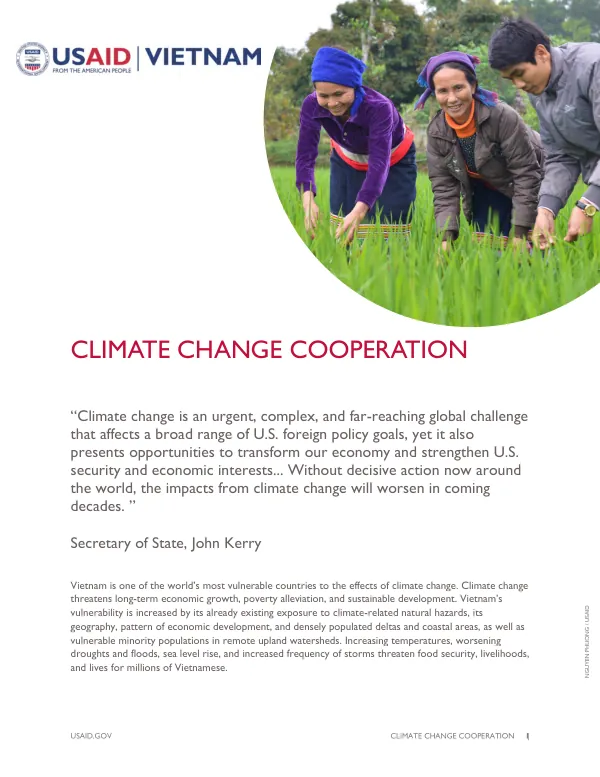
Climate Change Cooperation
Climate change is an urgent, complex, and far-reaching global challenge that affects a broad range of U.S.
2016 · 6 pages
Sign in to readA free account is required to download.
Abstract
foreign policy goals. Vietnam is one of the world's most vulnerable countries to the effects of climate change, with long-term economic growth, poverty alleviation, and sustainable development threatened by increasing temperatures, worsening droughts and floods, sea level rise, and increased frequency of storms. The United States and Vietnam are working closely together to tackle some of the most difficult environmental challenges of our day. The U.S. Government interventions accelerate Vietnam's transition to climate-resilient and low-emission sustainable economic development in accordance with U.S. Government and Government of Vietnam strategies. The U.S. Government supports the implementation of the U.S. President's Global Climate Change Initiative and Executive Order on Climate Action, and the U.S. Asia Comprehensive Energy Partnership. Vietnam is a focus country for the U.S. Government Enhancing Capacity for Low Emission Development Strategies (EC-LEDS) program, which aims to support partner countries' efforts to develop long-term strategic approaches to reduce greenhouse gas emissions while accelerating sustainable economic growth. Through engagement across sectors, the U.S. Government aims to improve health and well-being in Vietnam through climate-smart development and disaster mitigation. The United States Agency for International Development (USAID) mission in Vietnam is addressing climate change challenges through an integrated mitigation, adaptation, and disaster risk reduction approach. The current bilateral program is $54 million (FY 2013 to FY 2018). At the end of the current Global Climate Change program, Vietnam is expected to make measurable progress towards the transition to climate-resilient, lower-emission, sustainable growth. USAID assistance contributes towards strengthened sustainable low-emission economic development, increased clean energy investments and energy efficiency, decreased emissions resulting from improved land use practices, and strengthened rural and urban resilience to climate change and disaster risk reduction. The Green Growth Program (2014-2018) is a key instrument to help Vietnam pursue a green growth, low-emission development pathway through the implementation of the Vietnam Green Growth Strategy (Vietnam's LEDS) and Green Growth Action Plan at the national and provincial levels. Vietnam faces tremendous challenges in meeting its growing electricity needs, with consumption expected to more than triple between 2010 and 2020. To reduce the growth in emissions from the energy sector, USAID's clean energy interventions improve the enabling policy environment for clean energy and increase market incentives for the adoption of energy-efficient and renewable energy technologies. The Vietnam Clean Energy - Energy Efficiency Program (2012-2017) helps Vietnam promote energy efficiency in one of the highest energy-use sectors, the building sector. Sustainable landscape management is essential to curbing global emissions. USAID/Vietnam supports activities in the forestry and agriculture sectors and protection of livelihoods, watersheds, and biodiversity. Activities include strengthening incentive systems for forest protection and improving livelihoods and land use practices for forest- and agriculture-dependent communities. Adaptation and disaster risk reduction assistance build resilience in both cities and rural areas to minimize climate and disaster risks to human life and sustain communities' livelihoods and businesses.
Related documents