BANK FOR WEST AFRICAN DEVELOPMENT
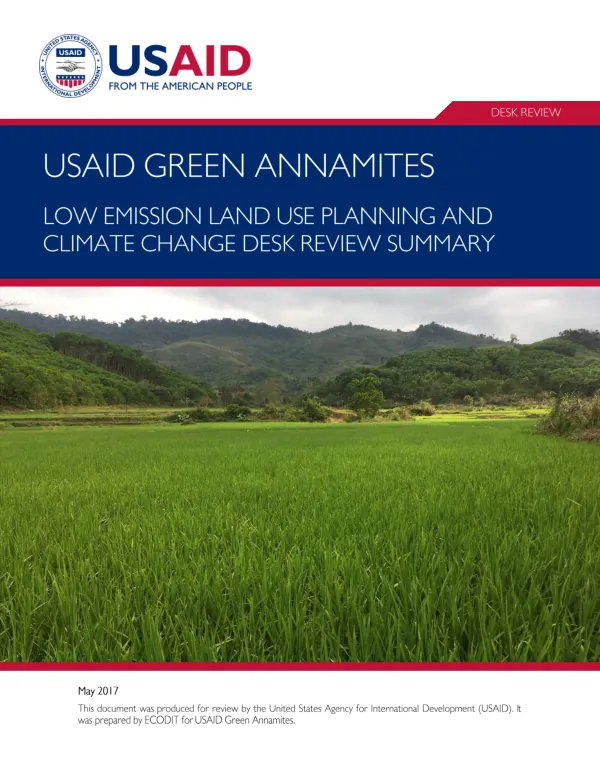
Low Emission Land Use Planning and Climate Change
The USAID Green Annamites project supports Vietnam's transition to climate-smart, low emission, and resilient development in Quang Nam and Thua Thien Hue provinces.
2017 · 20 pages
Sign in to readA free account is required to download.
Abstract
The project has three main tasks: increased application of low emission land use, strengthened biodiversity conservation, and increased resilience for vulnerable communities. The main purpose of the desk review is to identify the status, challenges, and opportunities in the two provinces related to Task I and Task III for the USAID Green Annamites project. The focus areas under Task I and Task III include low emission land use planning, livelihoods improvement, payment for forest environmental services (PFES), Reducing Emissions from Deforestation and Forest Degradation + (REDD+), improved forest monitoring system, and climate change/resilience. Low emission land use planning has been described in different ways in national government strategies and regulations. The Master Socio Economic Development Strategy (SEDS) and the 5-year Socio-Economic Development Plan (SEDP) are the foundations for all sector planning in the provinces. In Quang Nam, the SEDS was approved in 2005 for the 2005-2015 period, and the 5-year SEDP was approved by Provincial People Council in Resolution No. 177 dated December 11, 2015. In Thua Thien Hue, the SEDS was approved in 2009 for the 2009-2020 period. The Green Growth Action Plan (GGAP) is a key plan led by the Department of Planning and Investment in each province following the National Green Growth Action Plan prepared by the Ministry of Planning and Investment (MPI) approved in 2014. At the provincial level, land use planning is led by the Department of Natural Resources and Environment (DONRE) with a planning cycle of 5 years. The land use plan is approved by the Prime Minister. For the two project provinces, the updated land use plans to 2020 will be approved in 2017. Forest protection development planning is part of the land use planning, and led by the Department of Agriculture and Rural Development (DARD) in each province. Provincial governments have also developed a planning process to prepare the "3 types of forest plan" which aims to specify areas for different types of forests management and regulations. In Quang Nam, the "3 types of forest plan" process was approved in Decision 120, which stated clearly that USAID Green Annamites is one of the key priority projects. In Thua Thien Hue province, the "3 types of forest plan" process was approved in 2016. The plan also provides information on boundaries of forests and agriculture areas, reshaping the structuring of state forestry companies, and local development projects. Other cross sectors planning/plans are the Provincial REDD+ Action Plans described in Section 2.4. Livelihood improvement is a key priority in both provinces. In Quang Nam, the Provincial People's Committee (PPC) and the Department of Agriculture and Rural Development (DARD) priorities are to plant rattan, ginseng, and herbs in forest areas designated for protection, and develop agroforestry models with high economic value. In Thua Thien Hue, livelihood recommendations include introduction of new species in A Luoi District such as orange, banana, and vegetables, which can be linked to market and private sector demand. The Forest Protection Department (FPD) is responsible for proposals to develop medicinal plants and herb plantations in forest areas. A great financing opportunity to be explored is Huperzia serrata medicinal plant species that is used to cure Alzheimer's disease, which can be sold up to USD 5,000 per kilogram. This species can be found in Bach Ma National Park. The Asian Development Bank - Biodiversity Conservation Corridor (ADB-BCC) project provides valuable information on various livelihood approaches applied in 10 buffer zone communes based on commune investment profiles.