USAID DEC
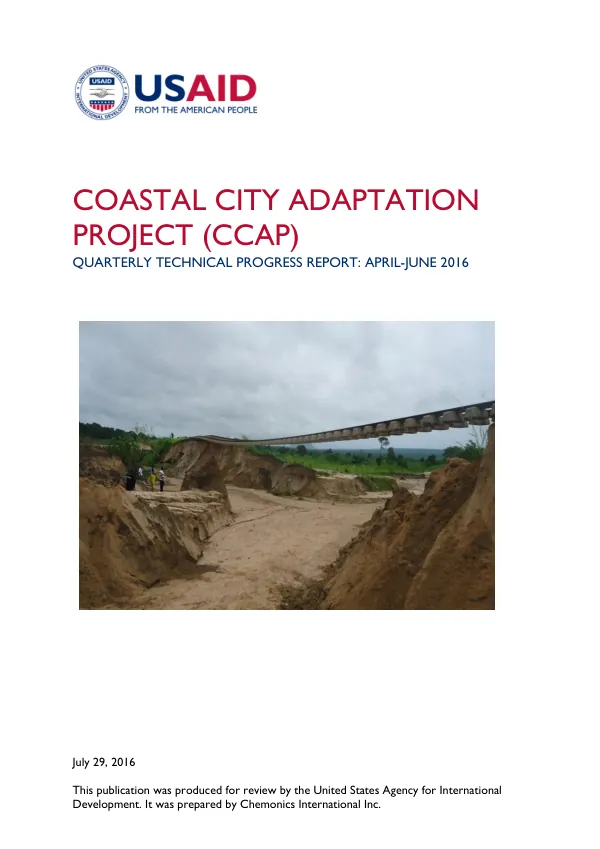
Coastal City Adaptation Project (CCAP) Quarterly Finance and Administrative Report: April - June 2016
Sign inCHEMONICS
Coastal City Adaptation Project (CCAP) Quarterly Finance and Administrative Report: April - June 2016
The Coastal City Adaptation Project (CCAP) is a USAID-funded initiative aimed at enhancing the resilience of coastal cities in Mozambique to climate-related events.
2016 · 6 pages
Sign in to readA free account is required to download.
Abstract
The project is implemented by Chemonics International Inc. and focuses on improving the capacity of local authorities, communities, and organizations to adapt to climate change. CCAP has made significant progress in signing memorandums of understanding (MoUs) with key stakeholders, including the Municipality of Pemba and Quelimane. These MoUs will facilitate partnerships with local and international networks working on climate change and disaster risk reduction issues. The project is also working to establish partnerships with Mozambican educational institutions, including the Faculty of Science of Eduardo Mondlane University (UEM), to facilitate knowledge generation and sharing of resources. The project has also made progress in resolving operational issues, including the recognition of the Chief of Party (COP) Maria Olanda Bata as the legal representative of Chemonics' foreign branch operating license for CCAP. The project is working with a local law firm to resolve issues related to delays in the submission of administrative filings to the Social Security Institute and the Tax Authority. In terms of staffing, Project Accountant Kátia Balate has transitioned to another USAID project based in Maputo, and CCAP has recruited Mr. Aderito Chivurre to serve as the new Project Accountant. He assumed his duties on July 13, 2016. CCAP has also made progress in implementing local grants, including a grant to the UEM Faculty of Science to prepare a tailored training program for municipal officials and other stakeholders. The Faculty of Science completed all training modules in May, and CCAP initiated the peer review process with professors from the University of Aveiro in Portugal and the University of Sao Paulo in Brazil. CCAP expects to receive the peer review findings in July and conduct the course during the next quarter. Other notable achievements include the completion of participatory assessment reports by UN-Habitat, which will inform the design of resilient housing activities. UN-Habitat is also preparing designs for pre-validation at public events in July and has completed the competitive process to contract with local partners in Pemba and Quelimane. The National Institute of Disaster Management (INGC) has obtained concurrence from USAID and the Municipality of Pemba to preposition emergency management kits in Mecufi and Quissanga, and CCAP has formally handed over the kits and assisted INGC to provide training to local emergency management committees. The Red Cross of Mozambique (CVM) has submitted a revised proposal to provide first aid training to INGC local disaster management committee members and selected community representatives in Pemba and Quelimane. The CCAP Selection Committee has evaluated the revised proposal and decided to proceed with grant award. The CCAP technical team has completed the draft project activity description for the annual program statement (APS), which aims to fund activities to increase the adoption of climate resilience measures by communities, civic, and community organizations in Pemba, Quelimane, and Nacala. The APS will be released in August, and CCAP expects to complete the APS and release it in August. In addition, the UEM Faculty of Forestry Engineering has assisted municipal officials in Pemba and Quelimane to finalize local adaptation plans (PLA) for submission for approval to their respective Municipal Assemblies. The UEM Department of Biological Sciences has led a rapid green infrastructure assessment in Pemba aimed at informing the Municipality and CCAP on interventions to best restore or expand specific green infrastructures in Pemba that serve to reduce residents' vulnerabilities to climate-related events.