USAID DEC
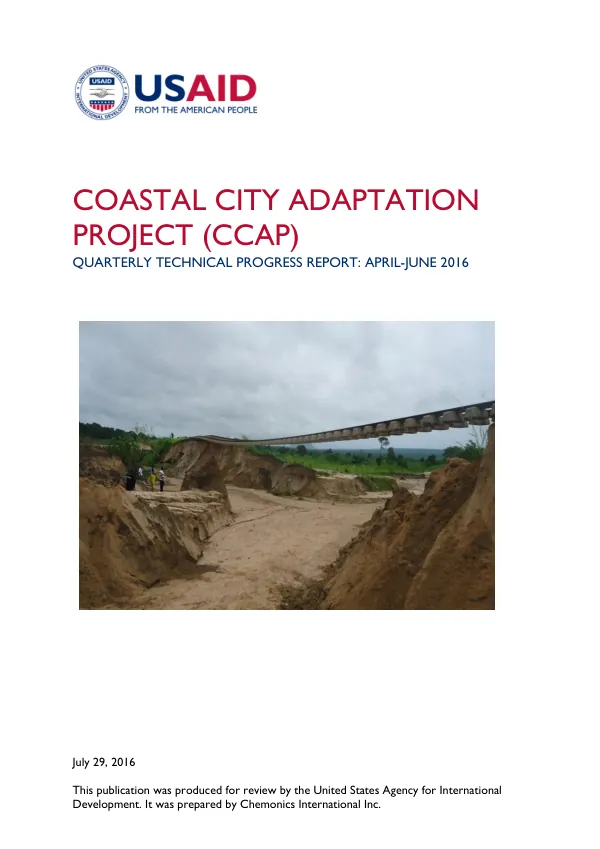
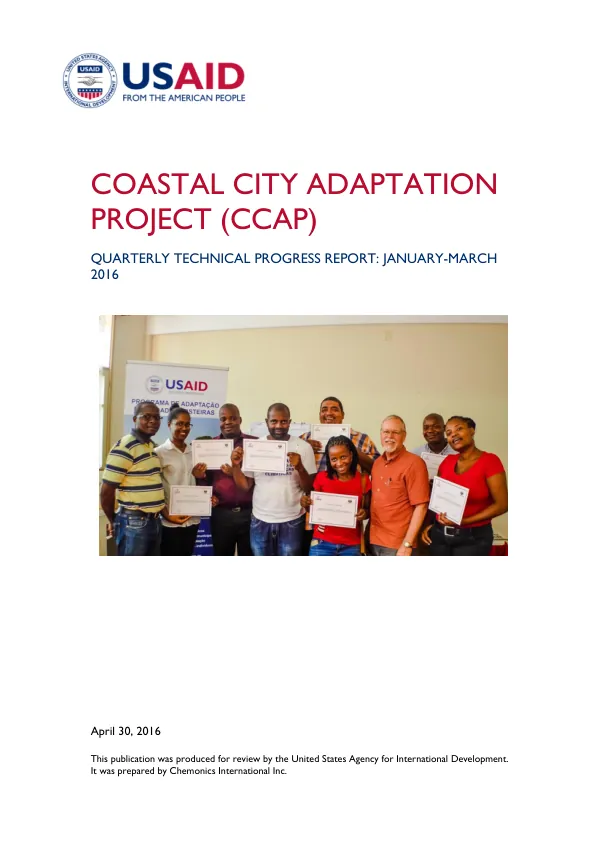
Coastal City Adaptation Project (CCAP) Quarterly Technical Progress Report: January-March 2016
Sign inCHEMONICS
Coastal City Adaptation Project (CCAP) Quarterly Technical Progress Report: January-March 2016
The Coastal City Adaptation Project (CCAP) is a five-year initiative aimed at increasing climate resilience in selected Mozambican coastal cities.
2016 · 17 pages
Sign in to readA free account is required to download.
Abstract
The project focuses its interventions in the vulnerable coastal cities of Pemba and Quelimane, with the goal of scaling up proven activities to additional cities along the Mozambican coast. CCAP's objective is to improve the provision of climate-resilient urban services by municipalities, increase adoption of climate resilience measures by communities, and increase the capacity to potentially implement economic risk-management tools, such as insurance plans and contingency funds, for at-risk urban infrastructure and livelihoods. The project's activities under Objective 1 focus on improving the capacity and technical skills of municipal authorities to plan, manage, and lead the execution of climate change adaptation and disaster risk reduction strategies. This includes participatory mechanisms for identifying and prioritizing adaptation options that combine technically credible and sound scientific analysis with engagement of vulnerable groups and communities. Under Objective 2, CCAP aims to increase community resilience to climate change by assisting Mozambican educational institutions to establish enduring partnerships with centers of global climate change expertise, building networks and information platforms for knowledge generation and resource sharing, and delivering trainings that equip individuals and community organizations with the skills to enhance resiliency in their local areas. CCAP initiated activities under Objective 3 during the current fiscal year, with the purpose of creating an enabling environment for improved access to risk pooling measures, such as insurance products and contingency funds through broad engagement with relevant government and private sector actors. During the reporting period, CCAP executed a memorandum of understanding with the Municipality of Nacala to guide joint efforts to enhance the city's climate resilience and contribute to its socio-economic development. The project also provided comprehensive training on environment compliance and impact mitigation to counterparts and selected partners in both Pemba and Quelimane. In Pemba, CCAP assessed the climate risks and housing situation in collaboration with UN-Habitat, while in Quelimane, resilient housing activities focused on the first steps to operationalize the housing designs, which consisted of discussions with local authorities and stakeholders on the city's climate change-related risks, resilient infrastructure typology, and criteria for siting the demonstration houses and for selecting beneficiaries. CCAP also assisted municipal officials in Pemba and Quelimane in developing local adaptation plans for municipal assembly approval. The project conducted a rapid assessment of existing green infrastructure in Pemba and an integrated urban information management system (SIGIU) assessment in Pemba. Key activities planned for the next quarter include the national launch of the 3-2-1 on-demand information system, implementation of soft-engineering management tools in Nacala, kick-off of resilient housing construction in Pemba, and finalization of the disaster risk reduction and climate change adaptation course.
Related documents