USAID DEC
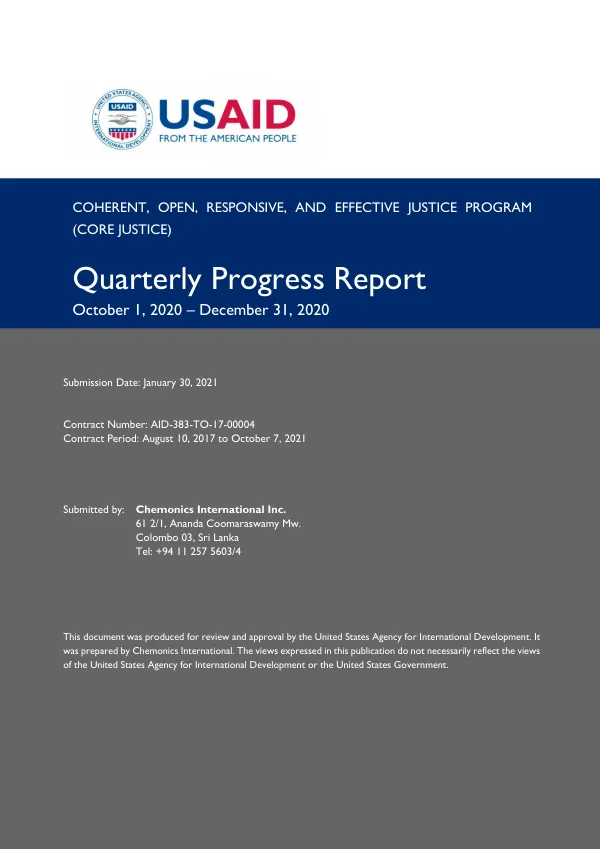
Coherent, Open, Responsive, and Effective Justice Program (CORE Justice) Quarterly Progress Report
Sign inCHEMONICS
Coherent, Open, Responsive, and Effective Justice Program (CORE Justice) Quarterly Progress Report
The USAID Coherent, Open, Responsive, and Effective Justice (CORE Justice) Program aims to improve the performance of core justice sector institutions and actors in Sri Lanka.
2021 · 47 pages
Sign in to readA free account is required to download.
Abstract
The program seeks to support the modernization of Sri Lanka's justice sector by strengthening the effectiveness of core justice institutions, processes, and actors, improving the justice system's transparency and citizen engagement, and enhancing the governance, qualifications, and diversity of the Sri Lankan legal profession. The program comprises three objectives: (1) strengthening the effectiveness of core justice institutions, processes, and actors; (2) improving the justice system's transparency and citizen engagement; and (3) enhancing the governance, qualifications, and diversity of the Sri Lankan legal profession. The program works closely with key stakeholders in the judiciary, government, legal profession, and civil society to achieve these objectives. The operating context for the program has been significantly impacted by the COVID-19 pandemic. The pandemic has had unparalleled impacts on public health, politics, and the economy, both locally and globally. In Sri Lanka, the government has introduced an alert level system to control the spread of the virus, and most major clusters have emerged in the Western Province, which includes Colombo. As a result, the Ministry of Health has issued notices reinforcing health and safety guidelines, and several measures have been taken to prevent community spread, including the lockdown of selected police areas, banning of events and public gatherings, and the closure of schools island-wide. The COVID-19 pandemic has had a significant impact on CORE Justice activities and counterpart engagement. Several counterparts have refused to engage in in-person meetings citing health and safety regulations and concerns. In-person counterpart engagement has been further limited due to the lockdown of selected police areas and the closure of schools. Despite these challenges, the program has continued to work with counterparts remotely and has adapted its activities to meet the changing needs of the justice sector. The program has made significant progress in achieving its objectives, despite the challenges posed by the COVID-19 pandemic. The program has strengthened the effectiveness of core justice institutions, processes, and actors, improved the justice system's transparency and citizen engagement, and enhanced the governance, qualifications, and diversity of the Sri Lankan legal profession. The program has also continued to work with counterparts to adapt to the changing needs of the justice sector and to ensure that the program's activities are responsive to the needs of the Sri Lankan people. The program has also made significant progress in implementing its activities, including the strengthening of core justice institutions, processes, and actors, the improvement of the justice system's transparency and citizen engagement, and the enhancement of the governance, qualifications, and diversity of the Sri Lankan legal profession. The program has also continued to work with counterparts to adapt to the changing needs of the justice sector and to ensure that the program's activities are responsive to the needs of the Sri Lankan people. The program's progress has been monitored and evaluated through regular monitoring and evaluation activities, including the collection of data on program outcomes and the assessment of program impact. The program has also continued to work with counterparts to adapt to the changing needs of the justice sector and to ensure that the program's activities are responsive to the needs of the Sri Lankan people. The program has also made significant progress in collaborating, learning, and adapting to the changing needs of the justice sector. The program has continued to work with counterparts to adapt to the changing needs of the justice sector and to ensure that the program's activities are responsive to the needs of the Sri Lankan people. The program has also continued to learn from its experiences and to adapt its activities to meet the changing needs of the justice sector. The program's progress has been recognized by the Sri Lankan government and other stakeholders, who have acknowledged the program's contributions to the modernization of Sri Lanka's justice sector. The program has also continued to work with counterparts to adapt to the changing needs of the justice sector and to ensure that the program's activities are responsive to the needs of the Sri Lankan people. The program's success has been attributed to its strong partnerships with counterparts, its ability to adapt to the changing needs of the justice sector, and its commitment to improving the performance of core justice sector institutions and actors in Sri Lanka. The program has also continued to work with counterparts to adapt to the changing needs of the justice sector and to ensure that the program's activities are responsive to the needs of the Sri Lankan people.