USAID DEC
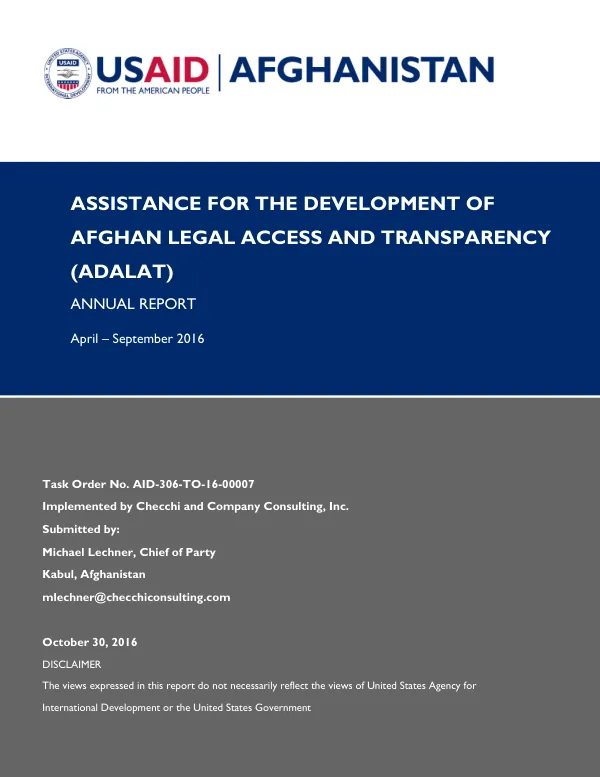
Assistance for the Development of Afghan Legal Access and Transparency (ADALAT) Annual Report
Sign inCHECCHI AND COMPANY, CONSULTING, INC.
Assistance for the Development of Afghan Legal Access and Transparency (ADALAT) Annual Report
The Afghanistan Assistance for the Development of Afghan Legal Access and Transparency (ADALAT) project began implementing its five-year program in Kabul on April 14, 2016.
2016 · 44 pages
Sign in to readA free account is required to download.
Abstract
The project's primary objective is to increase formal justice sector effectiveness, strengthen formal-traditional justice sector linkages, and increase citizen demand for quality legal services. During the second quarter of 2016, ADALAT moved into permanent office and housing space in early July and completed start-up activities begun in Quarter 1. The project continued to work with the Mission to review and revise the Year 1 work plan. ADALAT conducted numerous meetings with counterparts to obtain buy-in and lay the foundation for future cooperation and collaboration. Additionally, the project met with other international donor organizations working in the justice sector to facilitate greater coordination and prevent duplication of efforts. ADALAT presented the proposed Year 1 work plan to high-level representatives of the Supreme Court and the Huquq Department of the Ministry of Justice at the USAID offices. The project conducted a judicial training needs assessment, which involved interviews with key informants and focus group discussions with the Afghan Women Judges Association, members of the Afghanistan Independent Bar Association, and prosecutors in Kabul. ADALAT also obtained and compiled statistics from private and public Law and Sharia Faculties concerning curricula and enrollment/graduation data, disaggregated by sex. The project compiled laws and researched international standards to learn how other countries enforce judicial codes of conduct. ADALAT began planning the Kabul Regional Judicial Conference with the establishment of a planning committee composed of various departments and representatives from the Afghan Women Judges Association and ADALAT. The project established weekly meetings with the Supreme Court's Statistics Department to help improve the system by streamlining formats and making the statistics collected and reported more reliable, understandable, and user-friendly. ADALAT met weekly with the Afghanistan Independent Bar Association management and staff to collect baseline data, which may be used to design future interventions to strengthen the association's core capacities. The project drafted a work plan and monitoring and evaluation plan in collaboration with the association, including a logical framework. ADALAT coordinated a stakeholder working group meeting and discussed concerns about the association's by-laws. The project finalized a three-month bridge grant for the Afghanistan Independent Bar Association, designed to avoid funding gaps and support the association's operations in Kabul and its four regional offices. ADALAT led coordination efforts and collected data to ensure that other implementing partners were not providing duplicative funds for the same budget items that would be covered by ADALAT during the bridge grant period. ADALAT prepared the Afghanistan Independent Bar Association to launch several important activities, including an external audit, revisions to the association's by-laws, and a Human and Institutional Capacity Development (HICD) assessment. The project arranged for an international HICD expert to travel to Kabul to train staff about the assessment process. Dedicated teams from ADALAT began working with stakeholders to prepare assessment work plans, identifying key informants, and developing draft assessment tools. The project received a verbal agreement from the minister that the Ministry of Justice will begin requiring a formal induction Stage training for all new Huquq professional staff, starting approximately in March 2017. ADALAT worked with the Supreme Court and the Huquq department of the Ministry of Justice to prepare assessment work plans, identify key informants, and develop draft assessment tools for the Human and Institutional Capacity Development (HICD) assessment. Overall, ADALAT made significant progress in the second quarter of 2016, laying the foundation for future cooperation and collaboration with counterparts and stakeholders. The project continued to work towards its primary objectives, increasing formal justice sector effectiveness, strengthening formal-traditional justice sector linkages, and increasing citizen demand for quality legal services.