USAID DEC
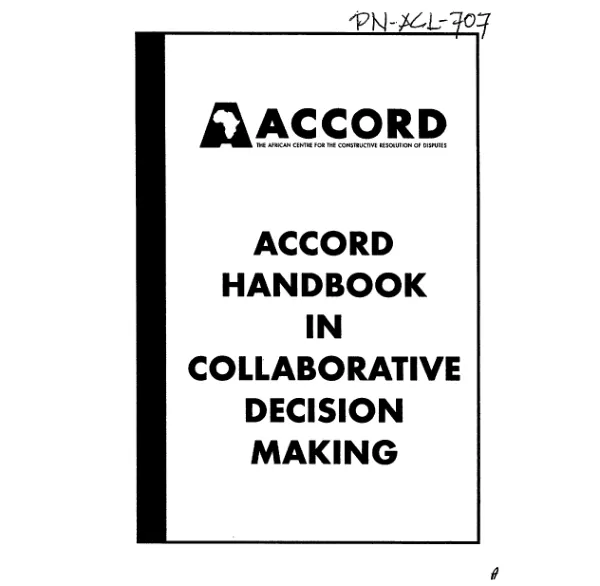
Collaborative Decision Making Handbook
Collaborative decision making is a process that involves multiple stakeholders working together to reach a consensus on a particular issue or problem.
33 pages
Sign in to readA free account is required to download.
Abstract
This approach is often used in situations where there are conflicting interests or diverse perspectives that need to be taken into account. A key aspect of collaborative decision making is the representation of stakeholder groups or key interests. This means that participants in the process should represent the views and concerns of their respective groups, rather than simply advocating for their own individual interests. All necessary interests should be represented or at least supportive of the discussions, and participants should share responsibility for setting the ground rules for the process and creating an outcome acceptable to all parties. An impartial facilitator, accountable to all participants, manages the process and maintains a safe atmosphere for communication. The intent is to make decisions through consensus rather than by voting, which can be a more time-consuming and inclusive process. A consensus process is more likely to be appropriate in situations where there are limited numbers of interests that will be significantly affected, and where there are individuals or entities that can represent those interests and are willing to participate. Additionally, a consensus process may be more suitable when dealing with diverse, complex issues, and when the outcome is in doubt. Several factors contribute to the success of collaborative processes, including a clear focus on the issues at hand, committed participants, leadership capacity, sound structure and process, and links to external constituencies. A clear focus is essential to making progress in a collaborative process, and committed participants are necessary to build trust and achieve consensus. Leadership capacity is also critical, as the group must have members with competence, drive, credibility with their constituency, and charisma. A sound structure and process, including broad representation, joint agreement on ground rules, and an impartial facilitator, can help ensure a productive atmosphere. When assessing whether to use a consensus process or not, agencies should consider factors such as the priority of the issues, the negotiability of the issues, the uncertainty of the outcome, the availability of time and resources, and the political climate. If these factors are present, an agency can proceed toward using a facilitated process. In convening a collaborative process, several questions should be asked, including what issues ought to be addressed, who the other significant parties are, what each party's basic interests are, and what parties have good reason to negotiate. Additionally, questions should be asked about the realistic objective for the outcome of any negotiation, the potential for closure, and the legal, resource, or other barriers to successful negotiation. Overall, collaborative decision making is a complex and nuanced process that requires careful consideration of multiple factors and stakeholders. By understanding the key principles and factors that contribute to its success, agencies and organizations can use this approach to reach more inclusive and effective decisions.