CONFLICT MANAGEMENT GROUP
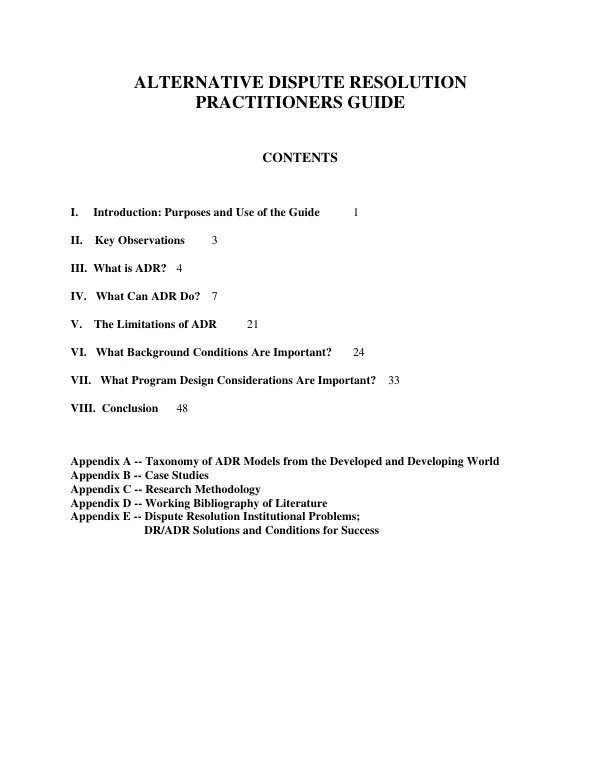
Alternative Dispute Resolution Practitioners Guide
Alternative Dispute Resolution (ADR) Practitioners Guide is a comprehensive resource designed to provide an introduction to the broad range of systems that operate under the rubric of ADR.
154 pages
Sign in to readA free account is required to download.
Abstract
The Guide is intended to explore and clarify the potential uses and benefits of ADR and the conditions under which ADR programs can succeed. The Guide draws on a critical mass of ADR experience, revealing important lessons as to whether, when, and how to implement ADR projects. It is written to help project designers decide whether and when to implement ADR programs in the context of rule of law assistance or other development initiatives. The Guide is also explicit about the limitations of ADR programs, especially where they may be ineffective or even counterproductive in serving some development goals. ADR is touted as more efficient and effective than the courts in providing justice, especially in countries where the judiciary has lost the trust and respect of the citizens. It is seen as a means to increase access to justice for populations that cannot or will not use the court system, to address conflicts in culturally appropriate ways, and to maintain social peace. Successful programs are improving the lives of individuals and meeting broad societal goals. The Guide reflects a broad review of English and Spanish language ADR literature pertaining to developing world experience. Relevant documents are summarized in the Working Bibliography, Appendix D. The Guide also incorporates key observations in the course of field assessments in Bangladesh, Bolivia, South Africa, Sri Lanka, and Ukraine, which are more fully described in the case studies, at Appendix B. Key observations highlighted in the Guide include the fact that ADR programs cannot be a substitute for a formal judicial system. However, ADR programs can complement and support judicial reforms. ADR programs can increase access to justice for social groups that are not adequately or fairly served by the judicial system, reduce cost and time to resolve disputes, and increase disputants' satisfaction with outcomes. When courts are systematically biased against women, ADR may be able to improve women's access to justice, especially when discrimination against women inherent in local norms or traditional dispute resolution mechanisms can be overcome in the new ADR mechanism. ADR programs can support not only rule of law objectives, but also other development objectives, such as economic development, development of a civil society, and support for disadvantaged groups, by facilitating the resolution of disputes that are impeding progress toward these objectives. Before developing an ADR program, it is critical to determine whether ADR is appropriate for meeting development objectives, or whether establishment of rights, strengthening of the rule of law, and/or creating a more even balance of power among potential users should precede the use of ADR. If ADR is appropriate in principle, program designers must assess background conditions to ensure that ADR will be feasible in practice. These include political support, institutional and cultural fit, human and financial resources, and power parity among potential users. If ADR appears feasible, program designers should ensure that the ADR program meets key preparation criteria, including needs assessment and identification of goals, participatory design process, adequate legal foundation, and effective local partner. In addition to meeting preparation criteria, program designers should also ensure that the ADR program meets implementation criteria, including effective selection, training and supervision of ADR providers, financial support, outreach, effective case selection and management, and program evaluation. The Guide also incorporates a Taxonomy of ADR at Appendix A, which provides definitions of key terms and a framework for understanding the basic and hybrid ADR systems that have emerged. The matrix found in Appendix E highlights central issues relevant to dispute resolution and potential solutions.
Related documents