USAID DEC
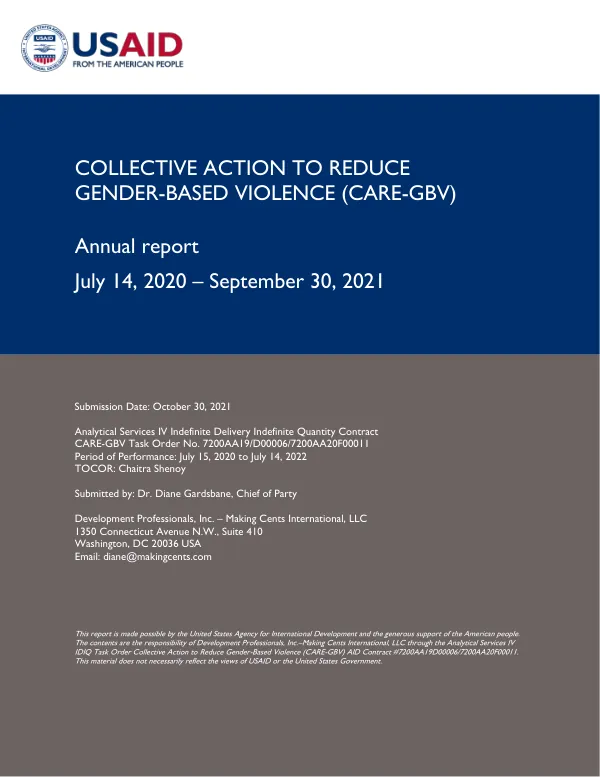
Collective Action to Reduce Gender-Based Violence (CARE-GBV) Annual Report July 15, 2020 – September 30, 2021
Sign inFHI 360
Collective Action to Reduce Gender-Based Violence (CARE-GBV) Annual Report July 15, 2020 – September 30, 2021
The Collective Action to Reduce Gender-Based Violence (CARE-GBV) activity is a two-year task order awarded to Development Professionals, Inc.-Making Cents International, LLC (DPI-MCI) on July 14, 2020 under the USAID Analytical Services IV indefinite delivery indefinite quantity contract.
2021 · 38 pages
Sign in to readA free account is required to download.
Abstract
The objective of CARE-GBV is to strengthen the gender-based violence (GBV) portfolio across USAID through the development of foundational elements for addressing GBV within USAID, strategic plans, research, training, and professional networking support. CARE-GBV aims to achieve results through innovative approaches that build on the extensive pool of resources already developed by USAID and its implementing partners, as well as the knowledge and resources created by other donors and organizations. The task order centers on strengthening USAID's collective prevention and response in GBV development programming across the Agency and addresses the following objectives: Objective 1, Objective 2, Objective 3, Objective 4, and Objective 5. During the reporting period, CARE-GBV accomplished several key milestones. For Objective 1, the team recruited 33 prestigious GBV experts for the FEs Technical Advisory Group (TAG), developed and finalized the FEs editable template, and launched four TAG subcommittees to work on different sections of the FEs. The team also conducted a desk review as part of the landscaping analyses to inform the FEs and completed and submitted the desk review on survivor-centered approaches in development programming. For Objective 2, the team developed global web-based interactive maps of the prevalence of child, early, and forced marriage (CEFM) and female genital mutilation/cutting (FGM/C) as well as related indicators across 119 countries. The team engaged the USAID GBV CoP and USAID mission and regional staff to inform the development of the maps and submitted maps and a dissemination plan to USAID for clearance. The team finalized and launched interactive maps on September 8, 2021, which were viewed more than 2,300 times in the first three weeks. For Objective 3, the team developed and disseminated the first of 10 how-to notes, How to Identify and Advance Equitable Social Norms. This note was also published in Spanish, French, and Arabic. In addition, parts of this document were adapted and used in the Bureau for Development, Democracy, and Innovation (DDI) and Land and Resource Governance's new technical brief on gender norms. The team also conducted several other activities, including providing a context analysis to understand what promotes and what constrains USAID GBV programming, as well as what USAID staff and other stakeholders believe is needed to ensure more high-quality GBV programming going forward. The team engaged the USAID GBV CoP and USAID mission and regional staff to inform the development of the maps and submitted maps and a dissemination plan to USAID for clearance. Overall, CARE-GBV has made significant progress in achieving its objectives and has developed several key products and tools to support USAID's GBV programming. The team has also engaged with various stakeholders, including USAID staff, implementing partners, and civil society organizations, to inform the development of the FEs and other products.